A head-to-head trial can answer a question that separate drug studies cannot: what happens when eligible participants are randomly assigned to one treatment or the other within the same experiment? SURMOUNT-5 provides that comparison for tirzepatide and semaglutide in adults with obesity without type 2 diabetes. At 72 weeks, the reported average weight reduction favored tirzepatide. That is meaningful evidence, but its meaning depends on the population, injectable regimens, outcome definitions, and follow-up actually studied.
Those boundaries matter when a treatment service turns a research result into an advertising claim. A difference between medicines does not establish a difference between platforms, pharmacies, or subscription plans. This analysis uses the indexed primary report abstracts for SURMOUNT-5 and three contextual trials, together with available official FDA material on compounded GLP-1 drugs. It does not represent a review of all full articles, protocols, or supplements.
At a glance
- Direct randomized comparison
- SURMOUNT-5 assigned 751 adults with obesity without type 2 diabetes to tirzepatide or semaglutide in a phase 3b, open-label trial.Sources: [1]
- Studied treatment strategies
- Participants received once-weekly subcutaneous injections at maximum tolerated doses: tirzepatide 10 or 15 mg, or semaglutide 1.7 or 2.4 mg, for 72 weeks.Sources: [1]
- Primary weight result
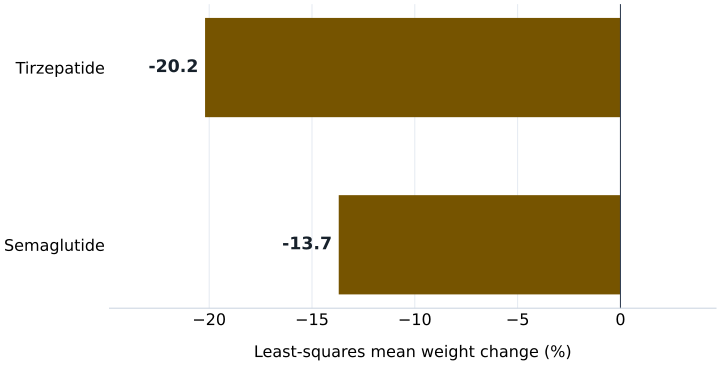
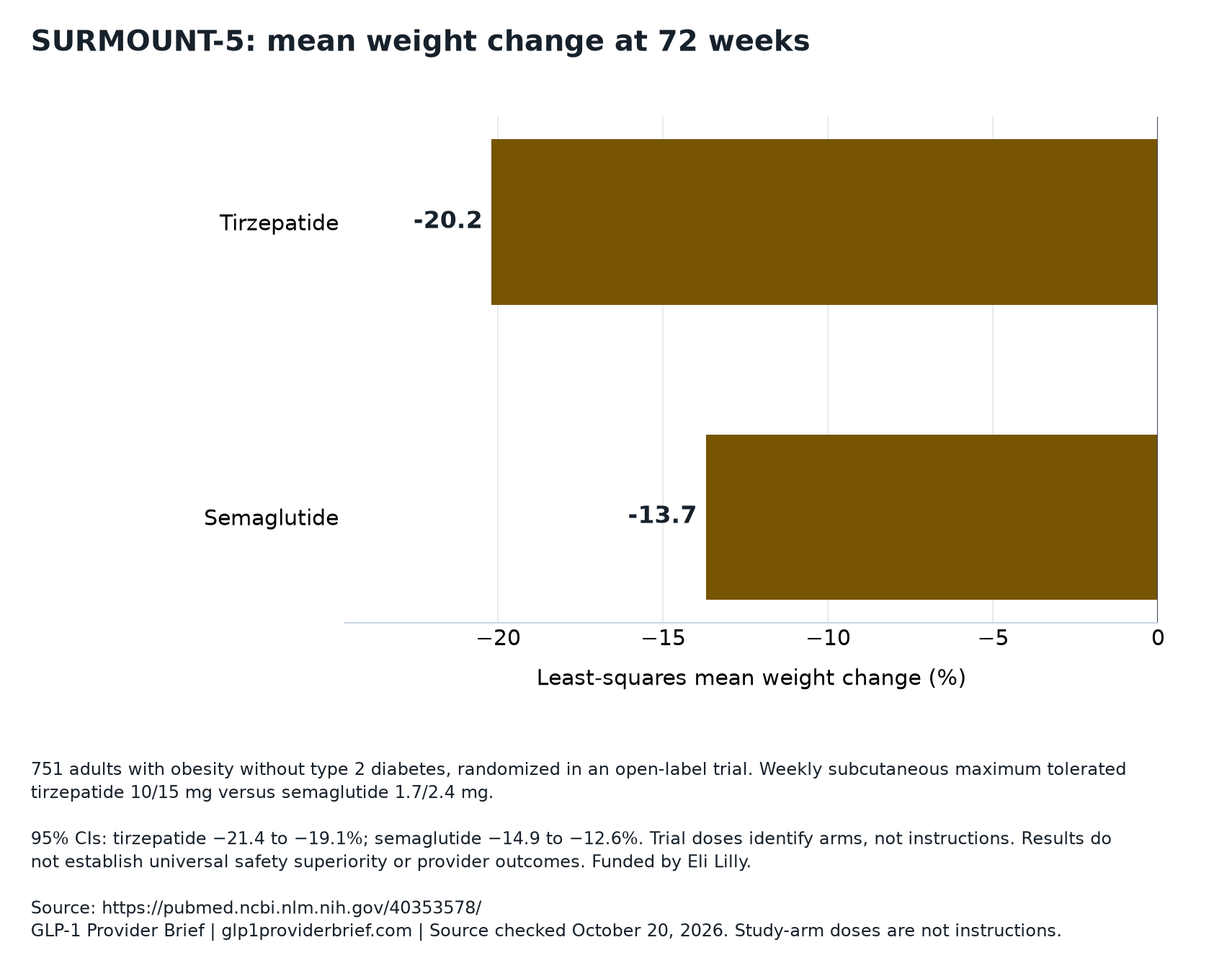
- Least-squares mean weight change was −20.2% with tirzepatide and −13.7% with semaglutide, a 6.5-percentage-point separation based on the reported rounded estimates.Sources: [1]
- Safety finding
- Gastrointestinal events were the most common adverse events in both groups; most were mild to moderate and occurred mainly during dose escalation. This does not establish universal safety superiority.Sources: [1]
Randomization makes this a stronger comparison than matching headlines
SURMOUNT-5 randomly assigned 751 participants in a 1:1 ratio to the two medicines. Random allocation reduces the chance that treatment choice is systematically tied to characteristics that also influence weight change. Unlike comparing unrelated studies, this design places both groups within one trial framework and one 72-week assessment period.
The trial was open-label: participants and investigators knew which treatment was assigned. That does not erase randomization, but it creates possible pathways for expectations to influence behavior, treatment persistence, or reporting. Weight is more objectively measured than a satisfaction rating, yet an objective measurement does not make every surrounding aspect of treatment immune to bias.
The study was funded by Eli Lilly. Sponsorship is relevant context, not a reason by itself to dismiss the findings. The accessible abstract supports a direct efficacy comparison, while leaving details about treatment adherence, missing measurements, and sensitivity analyses outside this analysis. Those details would help evaluate how robust the estimates are under different assumptions.
The result belongs to a population and a dosing strategy
The population was adults with obesity without type 2 diabetes. That description is narrower than everyone seeking weight management. It does not directly establish comparative effects in people with diabetes, adolescents, or every person with overweight. The abstract also does not provide enough demographic detail to judge how closely every prospective patient resembles the participants.
Both treatments were given by subcutaneous injection, meaning under the skin, once weekly. The trial compared maximum tolerated regimens: tirzepatide at 10 or 15 mg and semaglutide at 1.7 or 2.4 mg. These doses identify study arms, not instructions for readers. The result concerns those treatment strategies rather than every possible dose pairing.
Maximum tolerated dosing also means the comparison was not simply one fixed dose against another fixed dose. The abstract does not report how many participants finished at each permitted dose. A claim about the overall randomized strategies therefore cannot be rewritten as proof that each tirzepatide dose outperformed each semaglutide dose separately.
| Study feature | What was studied | What it does not establish |
|---|---|---|
| Population | Adults with obesity without type 2 diabetes | The same comparative effect in every other population |
| Tirzepatide arm | Weekly subcutaneous treatment; maximum tolerated 10 or 15 mg | An outcome for every dose or formulation |
| Semaglutide arm | Weekly subcutaneous treatment; maximum tolerated 1.7 or 2.4 mg | An outcome for oral semaglutide or other regimens |
| Follow-up and primary outcome | Percent weight change from baseline to week 72 | Lifetime benefit, post-treatment maintenance, or cardiovascular superiority |
| Trial structure | Randomized, open-label, active comparison | A blinded comparison or a ranking of treatment services |
STUDY DATA · GLP-1 Provider Brief
SURMOUNT-5: mean weight change at 72 weeks
751 adults with obesity without type 2 diabetes, randomized in an open-label trial. Weekly subcutaneous maximum tolerated tirzepatide 10/15 mg versus semaglutide 1.7/2.4 mg.
| Study group | Least-squares mean weight change (%) |
|---|---|
| Tirzepatide | -20.2 |
| Semaglutide | -13.7 |
95% CIs: tirzepatide −21.4 to −19.1%; semaglutide −14.9 to −12.6%. Trial doses identify arms, not instructions. Results do not establish universal safety superiority or provider outcomes. Funded by Eli Lilly.
Original visualization of published aggregate data. No individual prediction or provider performance is represented. Original research ↗
Reading the 6.5-percentage-point weight difference correctly
The primary endpoint was percentage change in weight from baseline to week 72. The least-squares mean was −20.2% for tirzepatide, with a 95% confidence interval of −21.4% to −19.1%, versus −13.7% for semaglutide, with an interval of −14.9% to −12.6%. Least-squares means are model-based estimates, rather than necessarily the simple arithmetic averages of all observed measurements.
Subtracting the reported rounded estimates gives 6.5 percentage points of additional average weight reduction with tirzepatide. That is not merely a 6.5% relative difference. For an illustrative baseline weight of 100 kg, changes of 20.2% and 13.7% translate to 20.2 kg and 13.7 kg. This example explains the scale of the percentages; it is not a prediction for a particular person.
The reported comparison had P<0.001, supporting a difference under the statistical model used. The abstract provides confidence intervals for each arm, but not an interval for their difference. Subtracting their interval endpoints would not produce a valid substitute. Nor do the group intervals describe where 95% of individual participants' weight changes fell.
Waist change and response thresholds add different information
Waist circumference was a key secondary outcome. Its least-squares mean change was −18.4 cm with tirzepatide, with a 95% confidence interval of −19.6 to −17.2 cm, and −13.0 cm with semaglutide, with an interval of −14.3 to −11.7 cm. The comparison had P<0.001. The rounded estimates differ by 5.4 cm, adding a second physical measurement to the weight result.
Participants assigned tirzepatide were also more likely to reach weight reductions of at least 10%, 15%, 20%, and 25%. These thresholds address a different question from the mean: how often did participants cross a specified level of loss? The abstract does not give the response percentages, so it cannot support a numerical probability for reaching any one threshold.
Neither endpoint directly measures body composition, strength, symptoms, or cardiovascular events. Waist reduction is not a measurement of how much fat versus lean tissue was lost. Likewise, a larger average weight change cannot establish how long that change lasts after treatment ends. Readers considering that separate question can consult the STEP 1 extension discussion, rather than treating week-72 results as evidence of indefinite maintenance.
The safety result is specific, not a blanket endorsement
In SURMOUNT-5, gastrointestinal adverse events were the most common events in both groups. Most were mild to moderate and occurred primarily during dose escalation. This identifies an important tolerability pattern, but the abstract does not provide event-by-event rates, serious-event counts, or treatment-discontinuation percentages.
Consequently, the accessible report supports neither a claim that the drugs had identical safety profiles nor a claim that one was safer overall. Superiority for weight reduction is an endpoint-specific finding. It does not settle comparative risks for every adverse effect, especially uncommon events that may require larger populations or longer observation.
Other trials illustrate why tolerability deserves its own analysis. In STEP 1, gastrointestinal events caused discontinuation in 4.5% of semaglutide participants versus 0.8% receiving placebo. In SURMOUNT-1, adverse events caused discontinuation in 4.3%, 7.1%, and 6.2% of participants in the tirzepatide 5-, 10-, and 15-mg groups, versus 2.6% with placebo. These are different studies and different discontinuation definitions; arranging those percentages into a head-to-head safety ranking would be misleading.
STEP 1 and SURMOUNT-1 explain the background, not the direct difference
STEP 1 enrolled 1,961 adults without diabetes who had obesity, or overweight with a weight-related condition. In this double-blind trial, weekly injected semaglutide 2.4 mg or placebo was combined with lifestyle intervention for 68 weeks. Mean weight change was −14.9% versus −2.4%; the estimated treatment difference was −12.4 percentage points, with a 95% confidence interval of −13.4 to −11.5. Novo Nordisk funded the study.
SURMOUNT-1, supported by Eli Lilly, randomized 2,539 adults without diabetes and with comparable broad weight-related entry criteria to weekly injected tirzepatide or placebo for 72 weeks, including 20 weeks of dose escalation. Mean weight changes were −15.0%, −19.5%, and −20.9% at 5, 10, and 15 mg, respectively, versus −3.1% with placebo. The 95% confidence interval for the 15-mg estimate was −21.8% to −19.9%.
These double-blind placebo comparisons established substantial weight effects for each medicine. Their results should not be subtracted to manufacture a randomized comparison between drugs. Follow-up, participant mix, trial conduct, and analysis choices can differ. STEP 1's −14.9% estimate and SURMOUNT-5's −13.7% estimate for semaglutide are therefore not contradictory measurements of one fixed, universally reproducible drug effect.
More weight loss does not automatically mean greater cardiovascular benefit
SELECT tested a different question in a different population: 17,604 adults aged 45 or older with established cardiovascular disease, BMI of at least 27, and no history of diabetes. Participants received weekly subcutaneous semaglutide 2.4 mg or placebo in a double-blind trial funded by Novo Nordisk. Mean follow-up was 39.8 months, substantially longer than SURMOUNT-5.
The primary outcome combined cardiovascular death, nonfatal myocardial infarction, and nonfatal stroke. It occurred in 6.5% of semaglutide participants and 8.0% of placebo participants. The hazard ratio was 0.80, with a 95% confidence interval of 0.72 to 0.90. That describes approximately a 20% lower hazard over follow-up, not a 20-percentage-point reduction in the observed event proportion; the rounded proportions differed by 1.5 percentage points.
A lower composite hazard does not establish that every component improved individually. Adverse events led to permanent treatment discontinuation in 16.6% versus 8.2%. The SELECT cardiovascular evidence therefore adds an outcome-specific benefit and a tolerability finding. SURMOUNT-5 cannot rank tirzepatide against semaglutide for cardiovascular protection merely because its weight endpoint favored tirzepatide.
Injectable trial evidence does not authenticate another formulation
SURMOUNT-5 tested weekly subcutaneous regimens. It did not compare oral products, compounded preparations, or every formulation bearing a related ingredient name. A change in route or preparation is not just a change in marketing language; it changes what evidence is needed to establish that the trial result applies.
FDA states that compounded drugs are not FDA approved and are not reviewed before marketing for safety, effectiveness, or quality. Its official material recommends compounded products only when a patient's needs cannot be met by an FDA-approved drug, and identifies concerns involving dosing errors and semaglutide salt ingredients. Adverse-event reports alone cannot establish event rates or prove causation.
The practical documentation question is therefore the identity of the actual prescribed and dispensed product, not simply whether an advertisement cites tirzepatide or semaglutide research. The guide to product terms helps separate that question from subscription language. Scientifically, results for the trial regimens are not evidence of equivalent quality, exposure, effectiveness, or safety for compounded preparations.
A defensible service claim must preserve the trial's qualifiers
A service can accurately describe SURMOUNT-5 as finding greater average weight and waist reduction with the studied tirzepatide strategy than with the studied semaglutide strategy at 72 weeks in adults with obesity without diabetes. It should preserve the route, comparison, time horizon, and group-average nature of the result. Removing those qualifiers turns a bounded research finding into a broader assertion.
Editorial interpretation: supporting a service claim requires two distinct kinds of documentation. The scientific reference supports what happened in the trial; written service documents establish what product, fees, responsibilities, and conditions the service actually describes. Neither substitutes for the other. The evidence-boundaries guide explains this distinction, while the written-quote guide addresses the documentary side.
A provider review is useful here only as a route to checking terms. For example, the Ro review can prompt questions about enrollment documents; it does not establish that the provider offers the studied regimen or reproduces its outcomes. SURMOUNT-5 randomized medicines, not treatment platforms, and offers no basis for a provider league table.
| Claim | What the evidence supports | What remains unproven |
|---|---|---|
| Greater average weight loss | Tirzepatide outperformed semaglutide under the studied 72-week strategies | The same result for every individual or dose pairing |
| Better overall treatment | Superiority for weight and waist endpoints | Universal superiority for safety, symptoms, or cardiovascular outcomes |
| Equivalent compounded results | No equivalence established by these trials | Comparable quality, effectiveness, and safety of a specific compounded preparation |
| A superior treatment service | No provider comparison was conducted | Better clinical outcomes from one platform or subscription |
| Guaranteed personal result | Group-level estimates and threshold comparisons | A guaranteed amount or timing of individual weight loss |
Guarantees and long-term promises need evidence of their own
The trial followed participants for 72 weeks, not indefinitely. Its abstract does not answer how the comparative result changes after treatment stops, whether the difference persists over many years, or which baseline characteristics reliably predict a larger individual benefit. Nor does it provide a validated method for matching every person to the better-performing medicine.
Editorial interpretation: a refund guarantee is a contractual promise, not a clinical endpoint. It may specify eligibility conditions, documentation, deadlines, and exclusions without demonstrating that a promised weight outcome is likely. The refund-boundaries guide addresses those terms. A financially enforceable promise and a scientifically validated prediction remain different things.
The same distinction applies to value claims. SURMOUNT-5 did not test subscription prices, pharmacy fulfillment, access delays, or support quality. A claim that one service delivers better value cannot be derived from the 6.5-percentage-point weight difference alone. Its cost and service assumptions would need to be stated separately rather than presented as findings from the clinical experiment.
Questions & answers
Does −20.2% mean most participants lost exactly one-fifth of their weight?
No. It is a model-based group estimate. Individuals could lose more or less, and the abstract does not provide the full distribution. The confidence interval describes uncertainty around the estimated group mean, not the range of personal outcomes.
Why is a randomized open-label trial still useful?
Random assignment strengthens the comparison by reducing systematic differences in who receives each treatment. Open-label treatment leaves room for expectations and behavior to influence results. These features coexist: the study provides stronger comparative evidence than unrelated trials, without eliminating every possible source of bias.
Can the older placebo trials tell us which drug causes fewer side effects?
Not reliably by comparing their percentages alone. STEP 1 reported gastrointestinal-related discontinuation, while SURMOUNT-1 reported discontinuation from adverse events overall. Different definitions, populations, and trial procedures make those numbers unsuitable for a simple safety ranking.
Does the larger weight effect establish better heart protection?
No. SURMOUNT-5's primary endpoint was weight change. SELECT established a cardiovascular composite benefit for semaglutide versus placebo in people with existing cardiovascular disease, but it did not compare semaglutide with tirzepatide. The two trials answer different questions.
What documentation matters when a service cites this study?
The claim should identify the trial population, injectable regimens, comparator, and 72-week endpoint. Separately, service documents should identify the actual product and contractual promises. A trial citation does not authenticate a compounded preparation, validate a provider's outcomes, or establish a personal guarantee.
Our assessment
SURMOUNT-5 provides persuasive direct evidence that the studied maximum tolerated injectable tirzepatide strategy produced greater average weight and waist reduction than the studied semaglutide strategy over 72 weeks in adults with obesity without diabetes. Its strongest use is that precise comparison. It does not establish universal safety superiority, cardiovascular superiority, equivalent results for other formulations, or better performance by any treatment service. Editorially, a credible service claim should keep those scientific boundaries visible and document its commercial promises separately.
Sources & documentation
Scientific and official sources consulted October 20, 2026. Study findings apply to the populations, products and time periods described; they are not provider outcome data.
- Tirzepatide as Compared with Semaglutide for the Treatment of Obesity. ↗
- Once-Weekly Semaglutide in Adults with Overweight or Obesity. ↗
- Tirzepatide Once Weekly for the Treatment of Obesity. ↗
- Semaglutide and Cardiovascular Outcomes in Obesity without Diabetes. ↗
- FDA concerns about unapproved GLP-1 drugs ↗