A claim that a weight-management treatment protects the heart deserves more scrutiny than a headline percentage. In SELECT, semaglutide reduced a combined outcome of cardiovascular death, nonfatal heart attack, or nonfatal stroke among adults with established cardiovascular disease and overweight or obesity, without diabetes. That is meaningful clinical evidence, but it is not proof that every person using a GLP-1 product receives the same benefit, or that a particular service can guarantee it.
The central distinction is between a trial result and a commercial promise. SELECT compared a specific weekly injectable regimen with placebo, with standard cardiovascular care and lifestyle counseling in both groups. This analysis uses the indexed primary report abstract and available official FDA material; it does not represent a review of all trial protocols, supplements, or full texts. Those accessible records establish the main findings while leaving some component-level, safety, and mechanistic questions unresolved.
At a glance
- Population
- SELECT enrolled 17,604 adults age 45 or older with preexisting cardiovascular disease, BMI of at least 27, and no history of diabetes.Sources: [1]
- Primary result
- The cardiovascular composite occurred in 6.5% with semaglutide and 8.0% with placebo; the hazard ratio was 0.80, with a 95% confidence interval of 0.72–0.90.Sources: [1]
- Two different measures
- The reported hazard ratio corresponds to a 20% lower hazard; subtracting the rounded event percentages gives a 1.5-percentage-point crude difference.Sources: [1]
- Time and tolerability
- Mean follow-up was 39.8 months. Adverse events led to permanent trial-product discontinuation in 16.6% with semaglutide versus 8.2% with placebo.Sources: [1]
- Regulatory context
- On March 8, 2024, FDA announced a cardiovascular-risk-reduction indication for Wegovy injection in adults with cardiovascular disease and overweight or obesity.Sources: [2]
SELECT studied prevention after cardiovascular disease was already present
SELECT was a secondary-prevention trial: participants already had cardiovascular disease before randomization. Eligibility required age 45 or older, a body-mass index of at least 27, and no history of diabetes. BMI relates weight to height; it was an enrollment criterion here, not a complete description of a person's cardiovascular risk. These requirements identify the population in which the trial directly tested the intervention.
That distinction matters because baseline risk influences the practical meaning of a relative effect. Someone who already has cardiovascular disease generally faces a different clinical situation from someone seeking weight management without known disease. SELECT did not randomize a general population without cardiovascular disease, so it cannot establish primary prevention—preventing the first development or manifestation of cardiovascular disease—in that broader group.
The placebo group's 8.0% observed event proportion provides a concrete reference for this trial's population and observation period. It is not an annual event rate or a universal estimate for adults with obesity. Nor does excluding diabetes mean participants were otherwise low risk: established cardiovascular disease was required.
The comparison tested an injection added to background care
The multicenter trial randomly assigned 8,803 participants to semaglutide and 8,801 to placebo in a double-blind design. Randomization helps separate treatment effects from differences in patient characteristics; blinding reduces the influence of knowing the assigned treatment. The semaglutide arm used 2.4 mg by subcutaneous injection once weekly. This dose identifies the studied arm, not an instruction for individual treatment.
Both groups received standard cardiovascular care and lifestyle counseling, according to FDA's announcement. The relevant comparison was therefore semaglutide versus placebo within that background of care, not medication versus doing nothing. SELECT does not show that an injection replaces established cardiovascular treatment, or that a commercial weight-management subscription reproduces the trial's care arrangements.
The trial was event-driven and designed to test superiority: whether semaglutide produced a better cardiovascular result than placebo. Novo Nordisk funded it. Sponsorship belongs in the interpretation, but it neither nullifies randomization nor removes the need to examine the endpoint, uncertainty, and tolerability data. The indexed abstract does not provide a complete account of trial operations.
STUDY DATA · GLP-1 Provider Brief
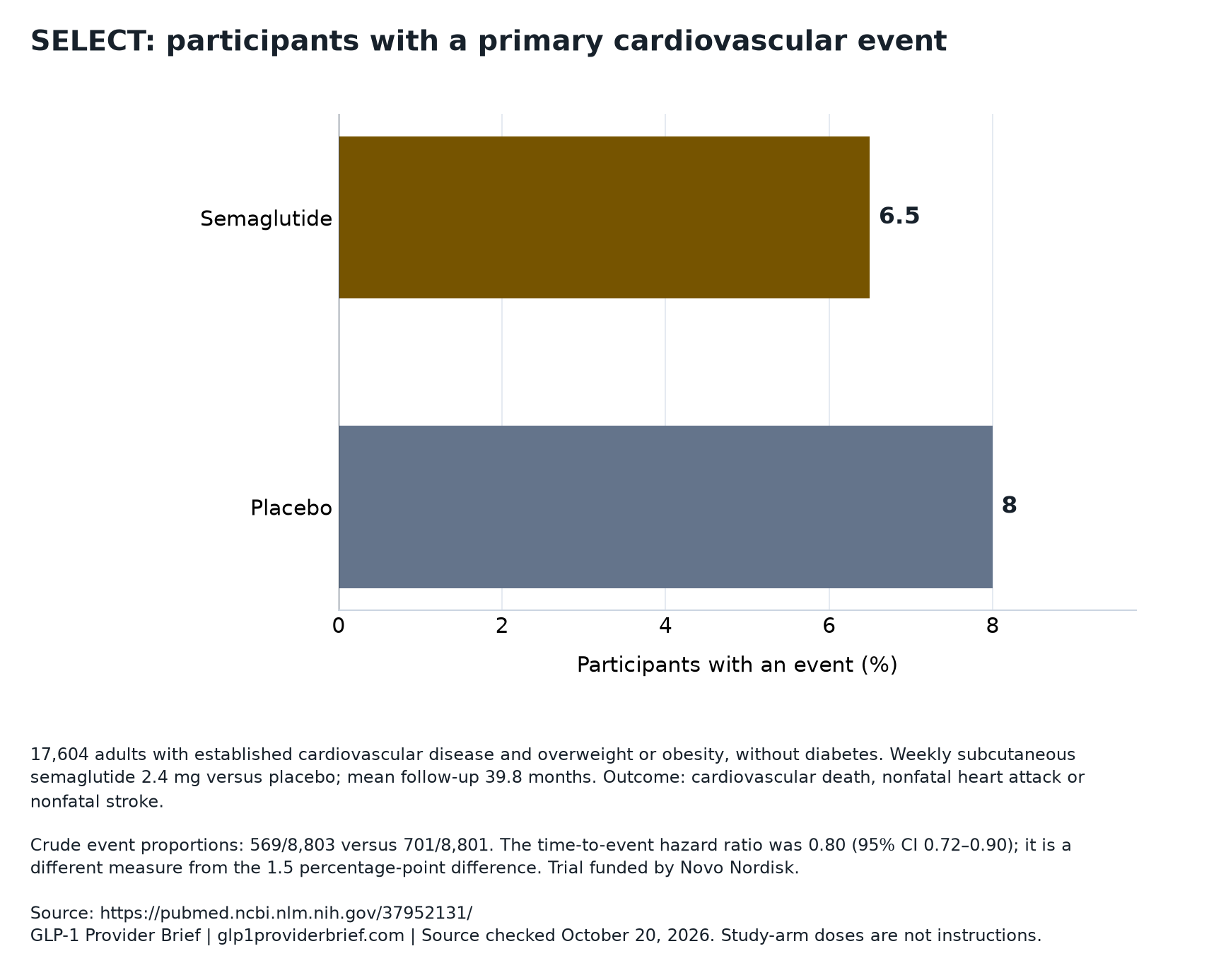
SELECT: participants with a primary cardiovascular event
17,604 adults with established cardiovascular disease and overweight or obesity, without diabetes. Weekly subcutaneous semaglutide 2.4 mg versus placebo; mean follow-up 39.8 months. Outcome: cardiovascular death, nonfatal heart attack or nonfatal stroke.
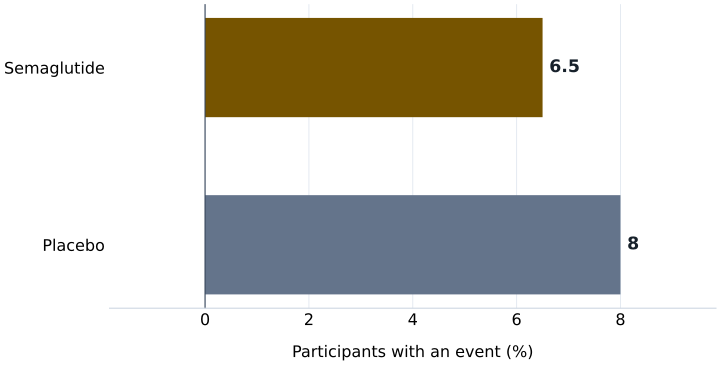
| Study group | Participants with an event (%) |
|---|---|
| Semaglutide | 6.5 |
| Placebo | 8 |
Crude event proportions: 569/8,803 versus 701/8,801. The time-to-event hazard ratio was 0.80 (95% CI 0.72–0.90); it is a different measure from the 1.5 percentage-point difference. Trial funded by Novo Nordisk.
Original visualization of published aggregate data. No individual prediction or provider performance is represented. Original research ↗
The primary endpoint combined three serious events
The primary endpoint combined death from cardiovascular causes, nonfatal myocardial infarction—commonly called a heart attack—and nonfatal stroke. A composite endpoint counts a defined set of outcomes together. This can make a trial more informative about an overall clinical question, but the combined result is not automatically a separate positive finding for each component.
SELECT used a time-to-first-event analysis. It considered when a participant first experienced one of the qualifying outcomes. That differs from counting every cardiovascular event, including repeated events in the same person. The primary result should therefore not be described as a measured reduction in the total number of all subsequent heart attacks and strokes.
The indexed abstract does not supply separate estimates for each component. It supports the combined endpoint but cannot, on its own, quantify a mortality-specific benefit or show that all three components improved independently. Advertising that turns the composite result into an identical reduction in heart attacks, strokes, and cardiovascular deaths goes beyond the evidence available here.
A 20% lower hazard is not a 20-percentage-point reduction
A first primary-endpoint event occurred in 569 semaglutide participants and 701 placebo participants. The reported proportions were 6.5% and 8.0%. Subtracting those rounded percentages gives a 1.5-percentage-point crude difference. Expressed descriptively, that is approximately 15 fewer participants with an event per 1,000 randomized participants over the observed trial period—not a forecast for every future group of 1,000 patients.
The hazard ratio answers a different question. A value of 0.80 corresponds to a 20% lower hazard, comparing event occurrence over follow-up among people still at risk of their first qualifying event. It is not a 20-percentage-point decline in event probability. Even the relative reduction calculated directly from the rounded proportions, about 18.8%, is not interchangeable with the time-to-event estimate.
The 95% confidence interval of 0.72–0.90 corresponds to an estimated hazard reduction ranging from about 10% to 28%. The interval excludes 1.0, the value representing no hazard difference. It describes statistical uncertainty around the trial estimate, not a range of benefits guaranteed to individual patients.
| Measure | Reported value or calculation | Meaning |
|---|---|---|
| Participants with a primary event | 569/8,803 versus 701/8,801 | Counts of participants experiencing a first qualifying event |
| Observed event proportions | 6.5% versus 8.0% | Crude proportions over trial observation, not annual rates |
| Crude absolute difference | 8.0% − 6.5% = 1.5 percentage points | Difference calculated from the rounded reported percentages |
| Hazard ratio | 0.80; 95% CI, 0.72–0.90 | Time-to-event comparison, corresponding to a 20% lower hazard |
Nearly 40 months of follow-up is not a lifetime forecast
Mean follow-up was 39.8 months, with a standard deviation of 9.4 months. Mean exposure to semaglutide or placebo was shorter: 34.2 months, with a standard deviation of 13.7 months. Follow-up describes observation time, whereas exposure describes time receiving the assigned trial product. Their difference is a reminder that being followed in a study and continuously taking its treatment are not identical.
These are averages, not a statement that everyone participated for exactly the same duration. The reported event percentages consequently summarize experience across differing observation times. Dividing 6.5% or 8.0% by a little more than three years would not reproduce the trial's time-to-event analysis or establish a constant annual risk.
The result also does not establish what happens over decades, after a particular individual stops treatment, or under a short commercial program. SELECT's abstract does not answer whether benefit persists after discontinuation. A claim tied to a brief service commitment should not silently borrow the evidentiary weight of a trial with substantially longer average follow-up.
Discontinuation is a substantial part of the benefit–harm picture
Adverse events led to permanent discontinuation of the trial product in 1,461 semaglutide participants, or 16.6%, compared with 718 placebo participants, or 8.2%. The difference between the rounded percentages is 8.4 percentage points. This is a tolerability finding with practical importance, not a minor footnote to the cardiovascular result.
Discontinuation because of an adverse event is not synonymous with a serious adverse event, and the indexed abstract does not enumerate the specific causes or provide a complete safety profile. It would be inappropriate either to label treatment universally safe or to assume every discontinuation represented severe injury. A balanced account preserves both the cardiovascular benefit and the higher frequency of adverse-event-related stopping.
Editorial interpretation: written service terms should make clear how treatment questions, adverse effects, and ongoing support are handled, without promising that support eliminates those risks. The support-pathways guide separates treatment communication from billing communication. Neither a contractual support promise nor SELECT's group-average result predicts an individual's tolerability.
Cardiovascular outcomes do not identify the mechanism of benefit
SELECT establishes a clinical outcome difference in the randomized comparison. The abstract does not establish how much of that difference arose through weight change, blood-pressure change, other biological effects, or combinations of pathways. Demonstrating a treatment effect and explaining the causal chain behind it are separate scientific tasks.
The result therefore should not be reframed as proof that losing a particular amount of weight produces a specific cardiovascular benefit. Conversely, the study's significance is not limited to a scale reading: it measured serious clinical events directly. The useful conclusion is about the tested treatment strategy and population, rather than an invented formula linking pounds lost to heart attacks prevented.
Unresolved questions include how benefit varies across patient characteristics and how it relates to treatment exposure over time. The accessible abstract does not report those subgroup or mediation analyses. Claims that every demographic group obtained the same effect, or that a provider's preferred monitoring approach explains the result, require evidence beyond this report.
FLOW and SUMMIT answer neighboring, not interchangeable, questions
FLOW studied 3,533 people with type 2 diabetes and chronic kidney disease, comparing weekly subcutaneous semaglutide 1.0 mg with placebo. Its primary composite included kidney failure, a large sustained-function-loss criterion, and kidney-related or cardiovascular death. Over median follow-up of 3.4 years, it reported 331 versus 410 first events and a hazard ratio of 0.76, with a 95% confidence interval of 0.66–0.88. The FLOW analysis explains that distinct kidney-focused question.
SUMMIT instead studied tirzepatide in 731 people with obesity and heart failure with preserved ejection fraction. Its cardiovascular-death-or-worsening-heart-failure composite occurred in 9.9% versus 15.3%, with a hazard ratio of 0.62 and a 95% confidence interval of 0.41–0.95, over median follow-up of 104 weeks. Cardiovascular deaths numbered eight versus five, with a very imprecise hazard ratio of 1.58. That illustrates why a favorable composite does not prove every component improved.
The SUMMIT analysis examines its heart-failure and health-status findings. Novo Nordisk funded FLOW; Eli Lilly funded SUMMIT. Neither was a head-to-head comparison with SELECT. Ranking their headline percentages would confound different drugs or doses, populations, endpoints, and follow-up periods.
An approved indication does not establish formulation equivalence
FDA's March 8, 2024 announcement described a cardiovascular-risk-reduction indication for Wegovy injection in adults with cardiovascular disease and overweight or obesity, alongside a reduced-calorie diet and increased physical activity. That announcement documents the regulatory action; it is not a substitute for current complete prescribing information or an individual eligibility assessment.
SELECT's evidence does not automatically transfer to oral semaglutide, different formulations, or compounded preparations. FDA states that compounded drugs are not FDA approved or reviewed before marketing for safety, effectiveness, or quality. Its concerns include dosing errors and semaglutide salt ingredients. Reports of problems alone cannot establish event rates or causation, but neither can a shared ingredient name establish clinical equivalence.
Editorial interpretation: the product description is an essential evidence check, not just a shopping detail. The product-terms guide helps distinguish what is being offered in writing. A cardiovascular claim should identify the relevant product and evidence rather than treating all GLP-1 preparations, routes, or suppliers as interchangeable.
| Claim | What the evidence supports | Boundary to preserve |
|---|---|---|
| Semaglutide reduced major cardiovascular events | A lower three-component endpoint in SELECT's defined population | Specify the studied injection, population, comparator, and follow-up |
| Heart risk fell by 20% | A hazard ratio of 0.80 for the composite | Not a 20-percentage-point absolute reduction or an individual guarantee |
| This prevents first cardiovascular disease | SELECT required preexisting cardiovascular disease | Primary prevention was not established by this trial |
| Our formulation or service delivers SELECT outcomes | The trial evaluated the assigned treatment, not a commercial provider | Product equivalence and provider outcomes need their own evidence |
Written claims need a chain from study to product to service
A defensible summary can state that, in SELECT's enrolled population, weekly injectable semaglutide reduced the hazard of the specified cardiovascular composite versus placebo over mean follow-up of 39.8 months. It should also preserve the observed event proportions and material discontinuation finding. That is more informative than an unqualified promise of heart protection.
Editorial interpretation: documentation should identify the cited trial, the population and endpoint, the product being discussed, and whether a statement concerns drug evidence or the service itself. The evidence-boundaries guide explains why clear contracts do not establish clinical outcomes. SELECT did not test a provider's enrollment process, membership model, response times, or refund policy.
Readers comparing services can use the CoreAge Rx review and Mochi Health review to check documentary terms, not to infer access to the studied product, condition-specific care, or cardiovascular results. A commercial guarantee cannot convert a probabilistic trial finding into certainty. Any separate service-performance claim needs evidence appropriate to that claim.
Questions & answers
Does SELECT show that semaglutide prevents cardiovascular disease in everyone with obesity?
No. Participants already had cardiovascular disease, were at least 45 years old, had BMI of at least 27, and had no history of diabetes. The trial directly supports secondary prevention in that studied population. It does not establish the same effect in people without cardiovascular disease or justify a universal prevention promise.
Why report both 20% and 1.5 percentage points?
They describe different measures. The 20% figure comes from the hazard ratio of 0.80 in the time-to-first-event analysis. The 1.5-percentage-point figure is the subtraction of the rounded observed event proportions, 8.0% minus 6.5%. Reporting both gives useful context without confusing a relative hazard comparison with a crude absolute difference.
Did SELECT prove fewer cardiovascular deaths specifically?
The indexed abstract establishes a reduction in the combined endpoint of cardiovascular death, nonfatal heart attack, or nonfatal stroke. It does not provide separate component estimates. On that evidence alone, a mortality-specific reduction cannot be quantified, and improvement in every component should not be assumed.
What does the discontinuation result tell us about real-world use?
It shows that adverse effects prevented a substantial minority from continuing the assigned product: 16.6% with semaglutide versus 8.2% with placebo. It does not specify the complete safety profile or predict an individual's experience. It also means that continued trial observation should not be mistaken for uninterrupted treatment exposure.
Can a compounded product or membership program cite SELECT as proof of equivalent results?
Not as proof of equivalence. SELECT tested a specific injectable treatment strategy, not a commercial membership or every semaglutide preparation. FDA states that compounded drugs are not reviewed before marketing for safety, effectiveness, or quality. Provider-level outcomes and formulation equivalence require their own supporting evidence.
Our assessment
SELECT provides strong randomized evidence of a lower hazard of major cardiovascular events with weekly injectable semaglutide in adults with established cardiovascular disease and overweight or obesity, without diabetes. Its clinical importance rests on directly measured events, not an assumed benefit from weight loss. The appropriate interpretation includes the 1.5-percentage-point crude event difference, nearly 40-month mean follow-up, and higher adverse-event-related discontinuation. For service claims, the dividing line is straightforward: a provider may accurately describe the research, but cannot turn it into proof of its own outcomes, formulation equivalence, primary prevention, or guaranteed individual protection.
Sources & documentation
Scientific and official sources consulted October 20, 2026. Study findings apply to the populations, products and time periods described; they are not provider outcome data.
- Semaglutide and Cardiovascular Outcomes in Obesity without Diabetes. ↗
- FDA cardiovascular indication for Wegovy, March 8, 2024 ↗
- Effects of Semaglutide on Chronic Kidney Disease in Patients with Type 2 Diabetes. ↗
- Tirzepatide for Heart Failure with Preserved Ejection Fraction and Obesity. ↗
- FDA concerns about unapproved GLP-1 drugs ↗