SUMMIT offers important evidence for people with obesity and heart failure with preserved ejection fraction, or HFpEF. In the randomized trial, tirzepatide lowered the occurrence of a combined outcome involving cardiovascular death or worsening heart failure and improved patient-reported health status. The central interpretive task is keeping those findings separate: fewer combined events does not mean that every component improved, and better health status is not the same outcome as longer survival.
That distinction matters when clinical research becomes a service advertisement. A claim about fewer worsening heart-failure events can be evidence-based; a promise that a subscription prevents cardiovascular death goes beyond this trial. This analysis uses the indexed primary report abstracts for SUMMIT, STEP-HFpEF, and SELECT, together with available official FDA material. It does not represent a review of their full protocols, supplements, or complete trial reports.
At a glance
- Population and comparison
- SUMMIT randomized 731 patients with heart failure, ejection fraction of at least 50%, and BMI of at least 30 to weekly subcutaneous tirzepatide or placebo.Sources: [1]
- Follow-up
- Treatment was assigned for at least 52 weeks; median follow-up was 104 weeks. Health status was assessed at 52 weeks.Sources: [1]
- Primary clinical composite
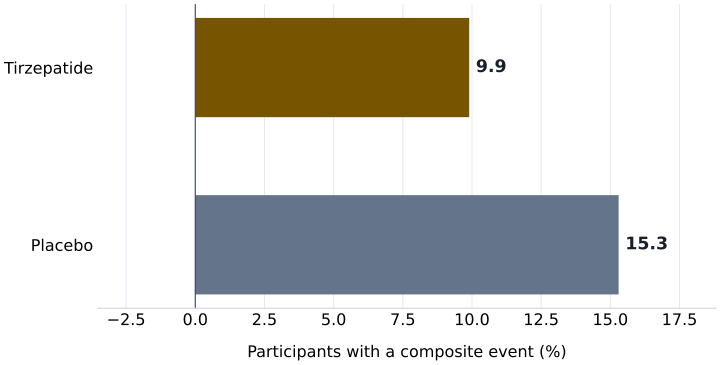
- Cardiovascular death or worsening heart failure occurred in 9.9% versus 15.3%; hazard ratio 0.62, 95% confidence interval 0.41–0.95.Sources: [1]
- Mortality uncertainty
- There were 8 cardiovascular deaths with tirzepatide and 5 with placebo; hazard ratio 1.58, 95% confidence interval 0.52–4.83. SUMMIT did not demonstrate an isolated cardiovascular mortality benefit.Sources: [1]
- Treatment discontinuation
- Adverse events, mainly gastrointestinal, led to trial-drug discontinuation in 6.3% of tirzepatide recipients and 1.4% of placebo recipients.Sources: [1]
The patients and treatment SUMMIT actually tested
SUMMIT enrolled 731 patients in an international, double-blind, randomized, placebo-controlled trial. Participants had heart failure, an ejection fraction of at least 50%, and a body-mass index of at least 30. Ejection fraction describes the proportion of blood expelled from the left ventricle with each contraction. A preserved percentage does not mean the person has no heart failure; it identifies a different clinical population from heart failure with reduced ejection fraction.
Investigators assigned 364 participants to tirzepatide and 367 to placebo. The intervention was a once-weekly subcutaneous injection, with a trial dose up to 15 mg. These details identify the research treatment, not a dosing recommendation. Random assignment and blinding strengthen the comparison by reducing systematic differences in who receives treatment and how expectations influence reporting.
Participants were assigned treatment for at least 52 weeks, and median follow-up was 104 weeks—approximately two years. A median is the midpoint of observed follow-up, not a statement that everyone was observed for exactly that long. Eli Lilly funded SUMMIT. The abstract does not establish that its findings apply equally to people below the BMI threshold, people without HFpEF, or every other heart-failure phenotype.
Two primary endpoints answered different questions
SUMMIT had two primary endpoints. One was a clinical composite: adjudicated cardiovascular death or a worsening heart-failure event, analyzed as time to the first event. Adjudication means that events were assessed for classification rather than simply accepted as unverified reports. The indexed abstract does not give the full operational definition of a worsening event, so its results should not be relabeled as a hospitalization-only endpoint.
The other primary endpoint was change in the Kansas City Cardiomyopathy Questionnaire clinical summary score, or KCCQ-CSS, from baseline to week 52. This 0-to-100 measure captures patient-reported heart-failure health status, with higher scores indicating better status. It asks a different question from the event endpoint: how people feel and function, rather than whether they experience a specified clinical event.
Keeping the endpoints separate prevents an important substitution. Improvement on a questionnaire cannot establish fewer deaths, while fewer clinical events do not by themselves quantify symptom relief. SUMMIT contributes evidence on both domains, but each has its own measurement scale, observation period, and uncertainty.
STUDY DATA · GLP-1 Provider Brief
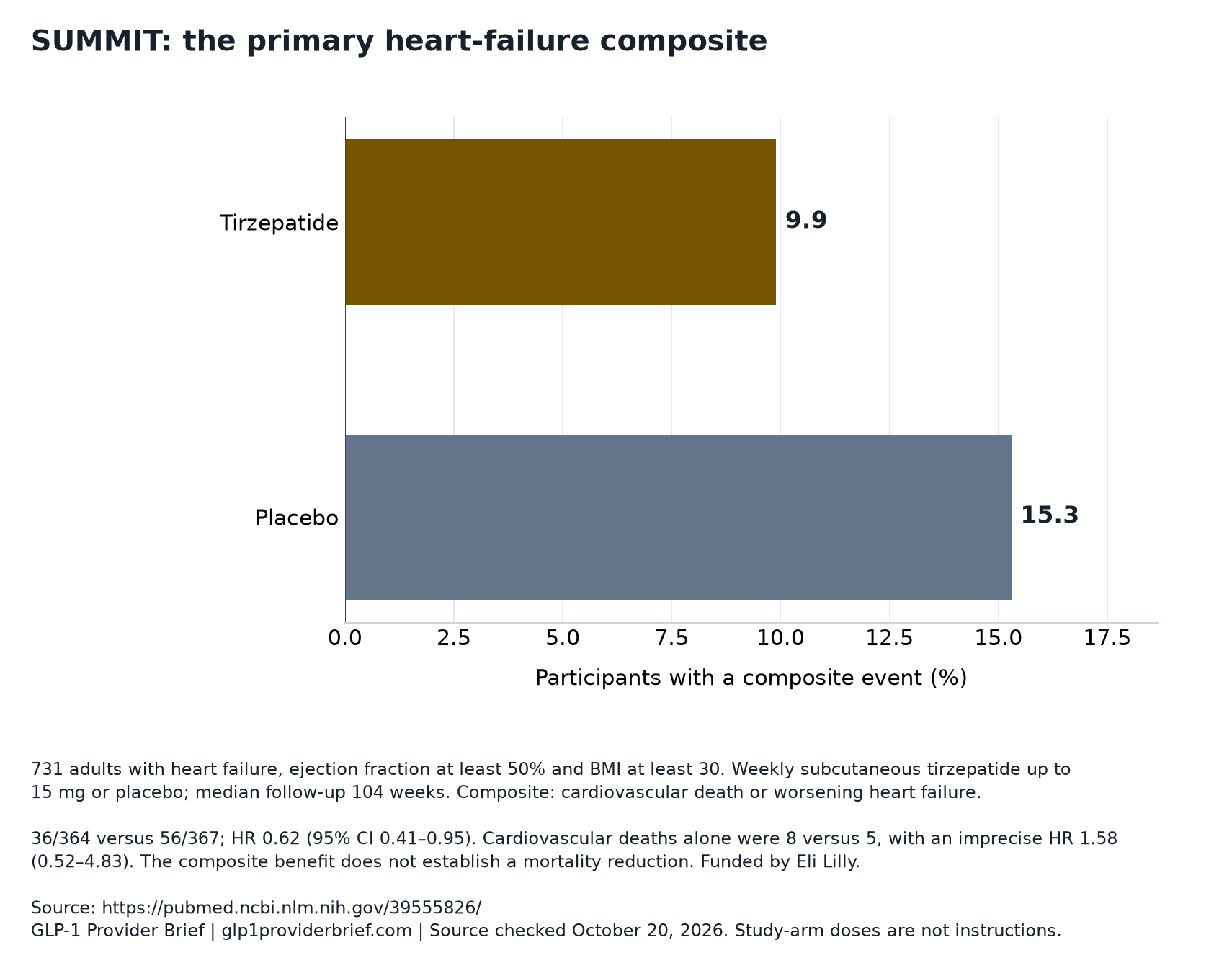
SUMMIT: the primary heart-failure composite
731 adults with heart failure, ejection fraction at least 50% and BMI at least 30. Weekly subcutaneous tirzepatide up to 15 mg or placebo; median follow-up 104 weeks. Composite: cardiovascular death or worsening heart failure.
| Study group | Participants with a composite event (%) |
|---|---|
| Tirzepatide | 9.9 |
| Placebo | 15.3 |
36/364 versus 56/367; HR 0.62 (95% CI 0.41–0.95). Cardiovascular deaths alone were 8 versus 5, with an imprecise HR 1.58 (0.52–4.83). The composite benefit does not establish a mortality reduction. Funded by Eli Lilly.
Original visualization of published aggregate data. No individual prediction or provider performance is represented. Original research ↗
What 9.9% versus 15.3% really means
The primary clinical composite occurred in 36 of 364 tirzepatide participants, or 9.9%, and 56 of 367 placebo participants, or 15.3%. Subtracting the reported percentages gives an observed difference of 5.4 percentage points. That is an absolute comparison within this study, not a prediction that every group of 100 patients treated elsewhere will experience exactly five fewer events.
The reported hazard ratio was 0.62, with a 95% confidence interval of 0.41–0.95. A hazard ratio compares event rates over time among participants still at risk; it is not the same measure as the ratio of the final percentages. Describing the estimate as a 38% lower hazard is appropriate. Calling it a 38-percentage-point reduction is not.
The confidence interval excludes 1 but extends from a substantial reduction to a comparatively small reduction in hazard. That supports a favorable trial result while leaving uncertainty about its magnitude. The abstract reports a time-to-first-event analysis, not a complete accounting of all recurrent heart-failure episodes or a universal two-year risk estimate.
| Outcome | Tirzepatide versus placebo | Reported hazard ratio (95% CI) |
|---|---|---|
| Cardiovascular death or worsening heart failure | 36/364 (9.9%) versus 56/367 (15.3%) | 0.62 (0.41–0.95) |
| Worsening heart-failure events | 29/364 (8.0%) versus 52/367 (14.2%) | 0.54 (0.34–0.85) |
| Cardiovascular death | 8/364 (2.2%) versus 5/367 (1.4%) | 1.58 (0.52–4.83) |
Why the composite is not a survival claim
Worsening heart-failure events occurred in 29 tirzepatide participants and 52 placebo participants. The corresponding hazard ratio was 0.54, with a 95% confidence interval of 0.34–0.85. This component provides the clearest favorable event signal. It supports describing fewer worsening heart-failure events in the studied population, without assuming that the mortality component moved in the same direction.
Cardiovascular deaths numbered 8 with tirzepatide and 5 with placebo. Their hazard ratio was 1.58, with a wide confidence interval of 0.52–4.83. The point estimate was above 1, but the interval encompassed both lower and substantially higher hazards. With only 13 cardiovascular deaths, this result neither demonstrates a mortality reduction nor establishes that tirzepatide increases cardiovascular mortality.
The component counts also cannot simply be added. In the tirzepatide group, 29 plus 8 equals 37, yet 36 participants experienced the composite; in the placebo group, 52 plus 5 equals 57, versus 56 with the composite. A participant can experience worsening heart failure and later cardiovascular death. The composite counts that person once at the first qualifying event, rather than treating overlapping component counts as separate people.
Health status improved, but not only with active treatment
At 52 weeks, mean KCCQ-CSS improvement was 19.5 points with tirzepatide and 12.7 points with placebo. The reported between-group difference was 6.9 points, with a 95% confidence interval of 3.3–10.6. Because published group changes are rounded, their simple subtraction need not exactly reproduce the reported treatment-effect estimate.
The placebo improvement matters. Crediting all 19.5 points to the drug would ignore the improvement observed under the comparison condition. The randomized between-group estimate is the more informative measure of the treatment effect. At the same time, an average difference cannot show how many individuals improved substantially, remained unchanged, or worsened; those response distributions are not given in the abstract.
SUMMIT therefore supports an average improvement in patient-reported health status alongside its clinical-event finding. It does not establish that every participant felt better or identify the precise biological pathway responsible. The related STEP-HFpEF analysis helps distinguish symptom and functional outcomes from trials designed around clinical events.
Tolerability is part of the result
Adverse events leading to trial-drug discontinuation occurred in 23 tirzepatide recipients, or 6.3%, and 5 placebo recipients, or 1.4%. These events were mainly gastrointestinal. The observed difference was 4.9 percentage points. This is a concrete treatment burden, even though discontinuation and a worsening heart-failure event are different outcomes and should not be treated as interchangeable units.
The abstract does not provide a complete adverse-event inventory, detailed symptom severity, or comprehensive long-term safety estimates. Its discontinuation result cannot support a blanket claim that the treatment was harmless. Conversely, a greater discontinuation rate does not erase the favorable composite result; benefit and tolerability need to be reported together.
Nor should these percentages be directly ranked against another trial's safety figures without checking what was counted. Serious adverse events, all gastrointestinal symptoms, and adverse events causing permanent discontinuation are distinct categories. Differences in populations, exposure, and follow-up also affect such comparisons.
STEP-HFpEF adds evidence, not a head-to-head comparison
STEP-HFpEF randomized 529 patients with HFpEF and BMI of at least 30 to once-weekly semaglutide 2.4 mg or placebo for 52 weeks. Its dual primary endpoints were KCCQ-CSS change and percentage weight change. Novo Nordisk funded the study. Unlike SUMMIT's primary clinical composite, this design centered on health status and weight.
The estimated KCCQ-CSS advantage was 7.8 points, with a 95% confidence interval of 4.8–10.9. Weight changed by −13.3% with semaglutide and −2.6% with placebo, an estimated difference of −10.7 percentage points. Six-minute walk distance improved by an estimated 20.3 meters more with semaglutide, with a confidence interval of 8.6–32.1 meters. These findings add functional information, not a direct comparison with tirzepatide.
STEP-HFpEF also reported a hierarchical composite win ratio of 1.72 and serious adverse events in 13.3% versus 26.7%. A win ratio ranks participants across ordered outcomes; it is not equivalent to SUMMIT's time-to-first-event hazard ratio. Similar questionnaire advantages across separate trials do not establish equal effectiveness, and different composite statistics cannot identify a superior drug.
| Trial and population | Intervention versus placebo | Primary outcome framework |
|---|---|---|
| SUMMIT: 731 patients; HFpEF, EF ≥50%, BMI ≥30 | Weekly subcutaneous tirzepatide, up to 15 mg | Cardiovascular death/worsening HF; KCCQ-CSS change |
| STEP-HFpEF: 529 patients; HFpEF, BMI ≥30 | Once-weekly semaglutide 2.4 mg | KCCQ-CSS change and percentage weight change at 52 weeks |
| SELECT: 17,604 patients; established cardiovascular disease, BMI ≥27, no diabetes history, age ≥45 | Weekly subcutaneous semaglutide 2.4 mg | Cardiovascular death, nonfatal myocardial infarction, or nonfatal stroke |
SELECT cannot supply SUMMIT's missing mortality answer
SELECT enrolled 17,604 people aged at least 45 with established cardiovascular disease, BMI of at least 27, and no history of diabetes. It compared weekly subcutaneous semaglutide 2.4 mg with placebo. Its primary composite combined cardiovascular death, nonfatal myocardial infarction, and nonfatal stroke—not worsening heart failure. Mean follow-up was 39.8 months.
Primary events occurred in 6.5% versus 8.0%, with a hazard ratio of 0.80 and a 95% confidence interval of 0.72–0.90. Adverse events caused permanent treatment discontinuation in 16.6% versus 8.2%. Novo Nordisk funded SELECT. These findings support its own population, drug, and endpoint; they cannot be imported into SUMMIT to turn an uncertain mortality component into a demonstrated survival benefit.
The SELECT evidence review explores that different cardiovascular question. Across these studies, the useful scientific conclusion is not that all weight-loss medications have interchangeable heart benefits. It is that specific interventions have produced specific benefits under different randomized comparisons.
Trial evidence does not establish product equivalence
A service using the word tirzepatide has not, by that name alone, demonstrated that its product and care reproduce SUMMIT. The study tested a specified injectable intervention under trial conditions. Results do not automatically transfer to oral routes, different formulations, compounded preparations, or the performance of a particular provider.
FDA states that compounded drugs are not FDA approved and are not reviewed before marketing for safety, effectiveness, or quality. It recommends compounded products only when a patient's needs cannot be met by an FDA-approved drug. Its concerns include dosing errors and semaglutide salt ingredients. Adverse-event reports alone cannot establish event rates or causation, but trial results likewise cannot establish equivalence for an unreviewed preparation.
Editorial interpretation: documentation should identify the actual product, formulation, route, dispensing pharmacy, and responsible clinical party before an advertisement borrows a trial's authority. The product-terms guide and provider-responsibilities guide organize those questions. Neither contractual clarity nor a shared ingredient name substitutes for clinical evidence.
What a defensible written service claim would say
A faithful summary would identify SUMMIT as a placebo-controlled study in patients with HFpEF and obesity, report the lower composite outcome, and distinguish the favorable worsening-heart-failure finding from the uncertain cardiovascular-death result. It would also mention improved health status and more adverse-event discontinuations. Trial doses describe study arms; trial reports are not current prescribing information.
Editorial interpretation: a provider claiming SUMMIT-level outcomes needs more than a citation. Its written claim should explain the population and endpoint being invoked, the actual product involved, and whether it is describing research rather than measured results from its own service. Promises of guaranteed survival, a fixed individual risk reduction, or proven equivalence for a compounded product exceed this evidence.
Financial promises require separate documentation. The refund-boundaries guide addresses what a guarantee actually covers. Readers comparing services can use the CoreAge Rx review to check documentary terms, not to infer that it offers SUMMIT's treatment or outcomes. The broader evidence-boundaries guide explains why clear contracts still do not prove clinical effectiveness.
Questions & answers
Did SUMMIT show that tirzepatide prevents cardiovascular death?
No isolated cardiovascular mortality benefit was demonstrated. There were 8 cardiovascular deaths with tirzepatide and 5 with placebo, with a hazard ratio of 1.58 and a wide 95% confidence interval of 0.52–4.83. The favorable primary result concerned cardiovascular death or worsening heart failure together, with the clearer favorable signal in worsening heart-failure events.
Why do the component counts exceed the composite count?
A person can experience both worsening heart failure and cardiovascular death. SUMMIT's time-to-first-event composite counts a participant once, at the first qualifying event. Adding component counts would double-count overlapping participants. The reported counts therefore are not separate, mutually exclusive groups that can simply be summed.
Does a hazard ratio of 0.62 mean my risk falls by 38%?
It describes an estimated 38% lower hazard in the randomized trial, not a guaranteed personal risk reduction. Individual absolute benefit depends on baseline risk and how closely a person's circumstances resemble the trial. The observed event percentages differed by 5.4 percentage points, which is a different measure from the hazard ratio.
Can these trials establish whether tirzepatide or semaglutide is better for HFpEF?
No. SUMMIT and STEP-HFpEF compared different drugs with placebo in separate trials, with different primary questions and follow-up structures. Their results cannot replace a direct randomized comparison. SELECT studied another population and cardiovascular composite, so its larger sample does not resolve that comparison either.
What evidence should accompany a provider's heart-benefit claim?
The claim should identify the study, eligible population, tested product and route, comparator, endpoint, follow-up, uncertainty, and relevant harms. Documentation should distinguish trial findings from the provider's own measured outcomes and financial promises. A citation to SUMMIT does not establish that a compounded formulation or a particular service delivers equivalent results.
Our assessment
SUMMIT supports a clinically meaningful but specific conclusion: among the studied patients with HFpEF and obesity, tirzepatide reduced a cardiovascular-death-or-worsening-heart-failure composite and improved average health status compared with placebo. Worsening heart-failure events favored treatment; cardiovascular mortality remained unresolved. More participants discontinued tirzepatide because of adverse events, mainly gastrointestinal. Editorially, the strongest service claim is therefore precise rather than sweeping: cite the population and endpoint, preserve the mortality uncertainty, disclose the product, and separate clinical evidence from contractual promises. The trial is evidence for a treatment comparison, not a certification of a provider.
Sources & documentation
Scientific and official sources consulted October 20, 2026. Study findings apply to the populations, products and time periods described; they are not provider outcome data.