A heart-failure treatment can matter because people feel and function better, even when a trial does not establish that they live longer. STEP-HFpEF makes that distinction important. Over 52 weeks, participants assigned to semaglutide had greater improvements in a heart-failure symptom and physical-limitation score, lost more weight, and increased their walking distance more than participants assigned to placebo. These are meaningful categories of evidence, but they are not interchangeable with fewer deaths.
For anyone evaluating a GLP-1 service’s written claims, the central question is whether the advertised promise matches the study’s population, product, comparison, and measured outcome. This analysis uses the indexed primary report abstracts for STEP-HFpEF, SUMMIT, and SELECT, together with available official FDA material on unapproved GLP-1 products. It does not draw on an examination of all full texts, protocols, or supplements. The strongest reading preserves both the trial’s positive findings and the boundaries around them.
At a glance
- Trial population and duration
- STEP-HFpEF randomized 529 people with heart failure with preserved ejection fraction and BMI of at least 30 to weekly semaglutide 2.4 mg or placebo for 52 weeks.Sources: [1]
- Symptoms and physical limitations
- Mean KCCQ-CSS improvement was 16.6 versus 8.7 points; the reported adjusted difference was 7.8 points, with a 95% confidence interval of 4.8 to 10.9.Sources: [1]
- Walking performance
- Six-minute walk distance increased by 21.5 versus 1.2 meters, an estimated between-group difference of 20.3 meters.Sources: [1]
- Composite interpretation
- The hierarchical composite favored semaglutide with a win ratio of 1.72; that is not a mortality risk ratio or a 72% reduction in heart-failure risk.Sources: [1]
The study tested a defined heart-failure population
Heart failure with preserved ejection fraction, or HFpEF, is not simply another name for excess weight or shortness of breath. It is a heart-failure category in which the fraction of blood pumped out of the heart remains preserved. STEP-HFpEF enrolled people who had both this condition and obesity, defined in the report as a body-mass index of at least 30.
Investigators randomly assigned 529 participants to once-weekly semaglutide at a study dose of 2.4 mg or placebo for 52 weeks. The semaglutide program studied an injectable intervention; the dose identifies the research arm, not a recommendation for an individual. Random assignment makes the comparison more informative than tracking people who chose treatment, because treatment selection itself can otherwise be related to health and prognosis.
The comparator matters: the question was how outcomes differed with semaglutide versus placebo within this trial, not whether a commercial service outperformed another service. Novo Nordisk funded STEP-HFpEF. Sponsorship is relevant context, while the randomized comparison and reported uncertainty remain the foundation for interpreting its results.
Two primary outcomes kept symptoms and weight separate
STEP-HFpEF had dual primary endpoints: change in the Kansas City Cardiomyopathy Questionnaire clinical summary score, or KCCQ-CSS, and change in body weight. An endpoint is a specified outcome used to judge treatment effects. Naming both outcomes made the trial more than a weight-loss study that happened to include people with heart failure.
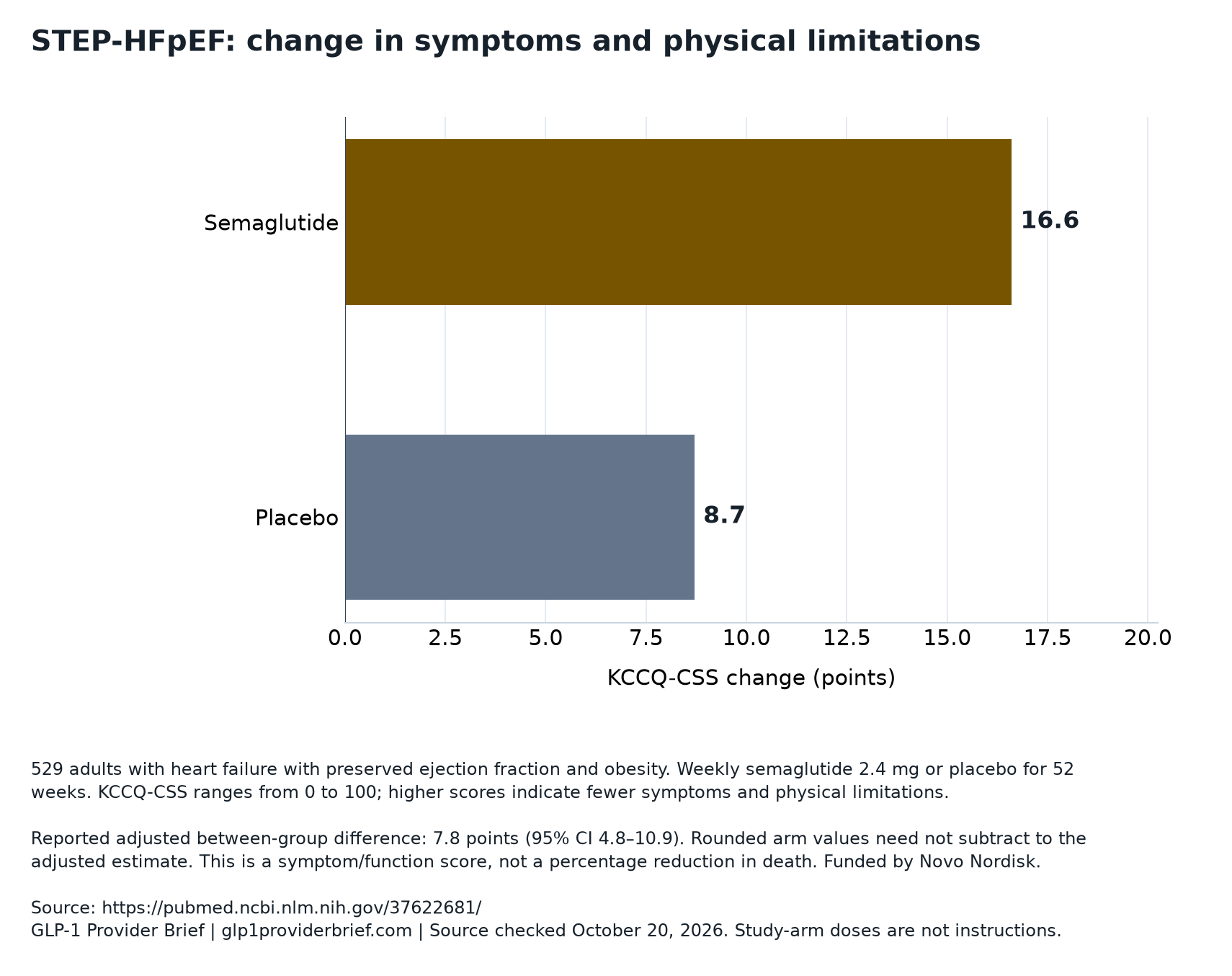
KCCQ-CSS ranges from 0 to 100, with higher scores indicating fewer symptoms and physical limitations. Mean improvement was 16.6 points with semaglutide and 8.7 with placebo. The reported adjusted between-group difference was 7.8 points, with a 95% confidence interval from 4.8 to 10.9. That interval describes the estimate’s precision under the analysis, not the range of responses every patient should expect.
Subtracting the rounded group means gives 7.9 rather than 7.8. This is not a reason to replace the published estimate: rounded descriptive values and an adjusted statistical estimate need not match exactly. Equally important, the full 16.6-point improvement cannot all be attributed to semaglutide. The placebo group also improved, so the comparative estimate is the more appropriate measure of treatment benefit.
STUDY DATA · GLP-1 Provider Brief
STEP-HFpEF: change in symptoms and physical limitations
529 adults with heart failure with preserved ejection fraction and obesity. Weekly semaglutide 2.4 mg or placebo for 52 weeks. KCCQ-CSS ranges from 0 to 100; higher scores indicate fewer symptoms and physical limitations.
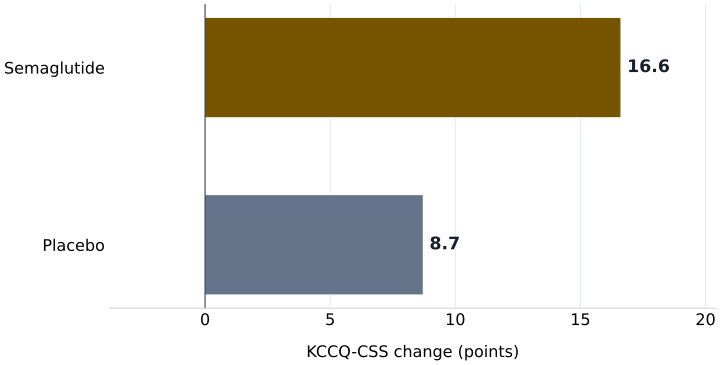
| Study group | KCCQ-CSS change (points) |
|---|---|
| Semaglutide | 16.6 |
| Placebo | 8.7 |
Reported adjusted between-group difference: 7.8 points (95% CI 4.8–10.9). Rounded arm values need not subtract to the adjusted estimate. This is a symptom/function score, not a percentage reduction in death. Funded by Novo Nordisk.
Original visualization of published aggregate data. No individual prediction or provider performance is represented. Original research ↗
Weight and walking results answer different questions
Mean percentage weight change was −13.3% with semaglutide and −2.6% with placebo. The estimated difference was −10.7 percentage points, with a 95% confidence interval from −11.9 to −9.4. Percentage points are essential here: the result compares two percentage changes, rather than describing a 10.7% relative reduction in some heart-failure outcome.
The six-minute walk test added a performance measure to the questionnaire findings. Mean distance increased by 21.5 meters with semaglutide and 1.2 meters with placebo, giving an estimated difference of 20.3 meters, with a 95% confidence interval from 8.6 to 32.1. This supports better measured exercise function on average, not a promise that every participant gained 20 meters or regained unrestricted activity.
The different measures reinforce one another without becoming interchangeable. Weight records body-size change, KCCQ-CSS captures reported symptoms and limitations, and walking distance measures performance during a standardized task. Their joint improvement does not reveal exactly how much symptom benefit was caused by weight loss versus other pathways.
| Measure | Semaglutide versus placebo | Reported comparative estimate |
|---|---|---|
| KCCQ-CSS change | +16.6 versus +8.7 points | +7.8 points; 95% CI, 4.8 to 10.9 |
| Body-weight change | −13.3% versus −2.6% | −10.7 percentage points; 95% CI, −11.9 to −9.4 |
| Six-minute walk change | +21.5 versus +1.2 meters | +20.3 meters; 95% CI, 8.6 to 32.1 |
| CRP change | −43.5% versus −7.3% | Treatment ratio 0.61; 95% CI, 0.51 to 0.72 |
A win ratio is not a mortality result
A confirmatory secondary endpoint combined death, heart-failure events, and differences in changes in KCCQ-CSS and walking distance through a hierarchy. Hierarchical analyses prioritize outcomes rather than treating every component as equally important. Their wins and losses summarize comparisons according to that ordering, so the resulting number answers a different question from a conventional event-risk estimate.
Semaglutide had a win ratio of 1.72, with a 95% confidence interval of 1.37 to 2.15. This means the hierarchical comparison favored semaglutide. It does not mean mortality fell by 72%, that participants were 72% more likely to survive, or that heart-failure events were reduced by that amount. The abstract does not provide enough component-level information to assign the composite advantage to any one outcome.
This distinction becomes clearer alongside the separate SUMMIT heart-failure analysis. SUMMIT assessed a time-to-first-event composite as one of its primary endpoints. Reading both reports requires keeping the statistical question attached to its answer; a favorable composite in one framework cannot be relabeled as a different outcome.
Inflammation changed, but the mechanism remains unresolved
C-reactive protein, or CRP, is a blood marker associated with inflammation. Its mean percentage change was −43.5% with semaglutide and −7.3% with placebo. The reported treatment ratio was 0.61, with a 95% confidence interval of 0.51 to 0.72. That ratio is the study’s comparative CRP estimate, not a hazard ratio for hospitalization or death.
The CRP finding is biologically informative because it accompanies changes in weight, symptoms, and function. Nevertheless, simultaneous changes do not prove a causal sequence. The abstract does not establish whether lowering inflammation produced the functional benefit, whether weight loss drove both, or whether several pathways contributed.
The trial therefore supports an effect of treatment assignment on measured outcomes more clearly than it explains the mechanism connecting them. Resolving those pathways would require analyses designed to separate interrelated changes. A provider claim that the treatment definitively reverses a particular inflammatory cause of HFpEF would go beyond this report.
Fewer serious adverse events is not the whole safety picture
Serious adverse events were reported in 35 semaglutide participants, or 13.3%, and 71 placebo participants, or 26.7%. The observed difference was 13.4 percentage points. This is an important safety finding, but serious adverse events are not synonymous with medication side effects: they include serious medical occurrences during follow-up, whether or not treatment caused them.
The indexed STEP-HFpEF abstract does not enumerate common adverse effects or provide a treatment-discontinuation breakdown. Those omissions limit the safety picture available here. They do not justify assuming that bothersome effects were absent, nor do they erase the favorable observed difference in serious events.
Other trials illustrate why safety categories must remain separate. In SUMMIT, adverse events leading to discontinuation were mainly gastrointestinal and occurred in 6.3% with tirzepatide versus 1.4% with placebo. In SELECT, permanent discontinuation because of adverse events occurred in 16.6% with semaglutide versus 8.2% with placebo. Different populations and follow-up periods prevent these figures from becoming a direct tolerability ranking.
SUMMIT adds event evidence, not a head-to-head verdict
SUMMIT randomized 731 people with heart failure, ejection fraction of at least 50%, and BMI of at least 30. It compared weekly subcutaneous tirzepatide, up to 15 mg, with placebo; median follow-up was 104 weeks. Eli Lilly funded the trial. Its primary outcomes included cardiovascular death or worsening heart failure and KCCQ-CSS change at 52 weeks.
The event composite occurred in 9.9% versus 15.3%, with a hazard ratio of 0.62 and a 95% confidence interval of 0.41 to 0.95. The observed proportion difference was 5.4 percentage points; the hazard ratio instead describes the relative event hazard over follow-up. Worsening heart-failure events favored tirzepatide, with a hazard ratio of 0.54, confidence interval 0.34 to 0.85.
Cardiovascular deaths were 8 versus 5, with a hazard ratio of 1.58 and a wide confidence interval of 0.52 to 4.83. Thus, the lower composite cannot be described as demonstrated lower cardiovascular mortality. KCCQ-CSS improved by 19.5 versus 12.7 points, with a reported difference of 6.9, confidence interval 3.3 to 10.6. None of these comparisons establishes superiority over semaglutide, because SUMMIT did not randomize participants between the two drugs.
SELECT addresses cardiovascular events in another population
SELECT enrolled 17,604 adults aged at least 45 who had established cardiovascular disease, BMI of at least 27, and no history of diabetes. It compared weekly subcutaneous semaglutide 2.4 mg with placebo. Mean follow-up was 39.8 months, and Novo Nordisk funded the study. Unlike STEP-HFpEF, its central question concerned major cardiovascular events rather than a symptom-and-weight pair.
Its primary composite—cardiovascular death, nonfatal heart attack, or nonfatal stroke—occurred in 6.5% versus 8.0%. The hazard ratio was 0.80, with a 95% confidence interval of 0.72 to 0.90. The observed absolute difference was 1.5 percentage points; the hazard ratio represents a different, time-based comparison. Neither figure is a STEP-HFpEF mortality estimate.
The SELECT cardiovascular-outcomes guide explores that distinction further. Together, the studies broaden the evidence base, but they do not create one universal heart-health promise: different eligibility criteria, endpoints, and follow-up periods determine which claim each study can support.
Product identity is part of the scientific claim
A trial result belongs to the intervention studied, not automatically to every product sharing an ingredient name. FDA states that compounded drugs are not FDA approved or reviewed before marketing for safety, effectiveness, or quality. It recommends compounded products only for patients whose needs cannot be met by an FDA-approved drug.
FDA also identifies dosing errors and problems involving semaglutide salt ingredients. Reports of problems alone cannot establish event rates or causation, but they provide concrete reasons not to assume equivalence. STEP-HFpEF does not validate compounded preparations, oral routes, other formulations, or a service’s dispensing and monitoring arrangements.
Editorial interpretation: written product terms and a clear account of platform, clinician, and pharmacy responsibilities help establish what a service actually supplies and who handles clinical questions. They do not establish that the service reproduces trial outcomes. Product documentation and clinical effectiveness are related questions, not substitutes for one another.
A defensible service claim names its boundaries
A faithful written claim can say that semaglutide improved average symptoms, physical limitations, weight, and walking performance versus placebo over 52 weeks in the studied HFpEF-and-obesity population. Supporting documentation should identify the trial, population, formulation, outcome, comparator, and time frame. It should not turn a group average into a personal guarantee.
Editorial interpretation: payment and refund promises require separate documentary scrutiny. A clinical improvement does not establish what a membership includes, how long charges continue, or when money is refundable. The billing-commitments guide addresses payment structure; the refund-boundaries guide addresses the scope of guarantees. Neither type of contract provision proves a health outcome.
For provider-specific document questions, the CoreAge Rx review can be used to check contractual terms—not as evidence that the provider offers the studied product, supplies HFpEF care, or achieves the trial’s results. The scientific boundary is straightforward: a trial supports a defined treatment comparison, not the entire service surrounding an advertisement.
| Claim | Evidence or documentation to check | Boundary |
|---|---|---|
| Improved HFpEF symptoms | STEP-HFpEF population, KCCQ-CSS results, comparator, and 52-week duration | An average benefit is not an individual guarantee |
| Reduced mortality | A directly relevant mortality analysis | STEP-HFpEF’s reported win ratio is not a mortality estimate |
| Equivalent compounded treatment | Product-specific evidence of equivalence | The clinical trial does not establish it |
| Guaranteed service or refund | Written inclusions, exclusions, deadlines, and payment obligations | Contract remedies are not clinical outcomes |
Questions & answers
Does a 7.8-point KCCQ-CSS difference mean everyone felt noticeably better?
No. It is the estimated difference between groups in average score change. Individual responses can vary, and the abstract does not give the distribution needed to describe each participant’s experience. The confidence interval concerns uncertainty in the comparative estimate, not a guaranteed personal improvement.
Did STEP-HFpEF prove that semaglutide prevents death?
The reported results do not establish that conclusion. Death was included in a hierarchical composite, but that analysis also incorporated heart-failure events, symptoms, and walking performance. Its win ratio cannot be converted into a mortality reduction without the relevant mortality evidence.
Can the trial tell us whether benefits persist beyond one year?
STEP-HFpEF’s reported comparison lasted 52 weeks. It supports conclusions over that period, not indefinite durability or what happens after treatment stops. Longer follow-up from other populations cannot automatically answer those questions for this particular HFpEF population and intervention.
Does SUMMIT show tirzepatide works better than semaglutide for HFpEF?
No. SUMMIT compared tirzepatide with placebo, while STEP-HFpEF compared semaglutide with placebo. Differences in design and follow-up make numerical cross-trial comparisons unreliable as proof of superiority. SUMMIT adds distinct event evidence, but it is not a randomized comparison between the two drugs.
Can a service cite STEP-HFpEF while selling a compounded preparation?
It can discuss the research accurately, but the citation does not establish that its preparation has equivalent efficacy, quality, or safety. FDA emphasizes that compounded products lack premarketing approval and review. A clear claim must distinguish the studied intervention from the actual product being supplied.
Our assessment
STEP-HFpEF provides persuasive randomized evidence of better average symptoms, physical function, and weight outcomes with semaglutide versus placebo over 52 weeks in people with HFpEF and obesity. Its consistency across questionnaire, walking, and weight measures strengthens that interpretation. The report does not establish a mortality benefit, identify the precise mechanism, or validate a provider’s program. The most credible service claims preserve those distinctions and separate clinical evidence from product identity, care responsibilities, and financial promises.
Sources & documentation
Scientific and official sources consulted October 20, 2026. Study findings apply to the populations, products and time periods described; they are not provider outcome data.