A claim that a GLP-1 treatment protects kidneys can sound straightforward. The FLOW trial supplies substantial evidence behind that idea, but its meaning depends on who received treatment and what investigators counted. FLOW studied people with type 2 diabetes and established chronic kidney disease, not an unrestricted population seeking weight loss. Its main outcome combined severe kidney deterioration with kidney-related or cardiovascular death.
The results support a clinically important benefit while leaving several questions open: how much each individual endpoint contributed, how long protection persists, and whether findings apply outside the studied population. This analysis uses the indexed primary report abstract and available official material, rather than a review of all full texts, protocols, or supplements. It also separates clinical evidence from a second question: what a commercial service would need to document before invoking FLOW in its advertising.
At a glance
- Population
- FLOW randomized 3,533 participants with type 2 diabetes and chronic kidney disease defined by both eGFR and urinary albumin-to-creatinine ratio.Sources: [1]
- Studied intervention
- Participants received once-weekly subcutaneous semaglutide 1.0 mg or placebo; this identifies the trial arms, not an individual treatment instruction.Sources: [1]
- Primary result
- There were 331 versus 410 first primary-outcome events; the hazard ratio was 0.76, with a 95% confidence interval of 0.66–0.88.Sources: [1]
- Observation period
- Median follow-up was 3.4 years, after early trial cessation was recommended at a prespecified interim analysis.Sources: [1]
- Safety finding
- Serious adverse events occurred in 49.6% of semaglutide participants and 53.8% of placebo participants; this does not establish that every type of adverse effect was less frequent.Sources: [1]
FLOW began with kidney disease, not a weight-loss audience
FLOW required both type 2 diabetes and chronic kidney disease. Eligibility depended on two measurements: estimated glomerular filtration rate, or eGFR, and urinary albumin-to-creatinine ratio, or UACR. eGFR estimates kidney filtering function and is standardized to a body-surface area of 1.73 square meters. UACR measures albumin in urine relative to creatinine; it captures a different dimension of kidney disease than filtration alone.
The two eligibility bands paired better-preserved filtering function with a higher minimum albumin level, and lower filtering function with a lower minimum albumin level. This matters because someone with a similar eGFR but little urinary albumin would not necessarily meet FLOW’s criteria. Nor would someone without diabetes qualify simply because a commercial service described them as having metabolic risk.
These boundaries are central to applicability, not minor technical details. FLOW provides direct randomized evidence for a defined diabetes-and-kidney-disease population. Extending its result to everyone with obesity, everyone using semaglutide, or everyone with an abnormal kidney test would require additional evidence. The abstract does not establish results separately for every combination of baseline filtration and albuminuria.
| Eligibility band | eGFR, mL/min/1.73 m² | UACR, mg/g |
|---|---|---|
| Higher eGFR band | 50–75 | Greater than 300 and less than 5,000 |
| Lower eGFR band | 25 to less than 50 | Greater than 100 and less than 5,000 |
Randomization tested a specific injectable regimen against placebo
Investigators randomly assigned 1,767 participants to semaglutide and 1,766 to placebo. Randomization makes the comparison more informative than following people who independently choose different treatments: it reduces the chance that baseline differences explain the outcome. The studied intervention was subcutaneous semaglutide at 1.0 mg weekly. Neither an oral formulation nor a broadly defined GLP-1 service was the intervention.
The comparator also defines the question. FLOW tested semaglutide against placebo, not against another GLP-1 medicine, a different semaglutide dose, or a competing provider’s program. The indexed abstract does not provide a complete inventory of background treatment or enough detail to reconstruct how every concurrent medicine was managed. It therefore cannot settle all questions about comparative effectiveness or combinations.
Novo Nordisk funded the trial, registered as NCT03819153. Funding is relevant context, but it does not by itself determine whether the result is valid. More useful scrutiny concerns the randomized comparison, prespecified endpoints, uncertainty estimates, and reporting boundaries. Those features support interpreting FLOW as evidence about a particular treatment strategy in its enrolled population—not as a ranking of commercial care models.
STUDY DATA · GLP-1 Provider Brief
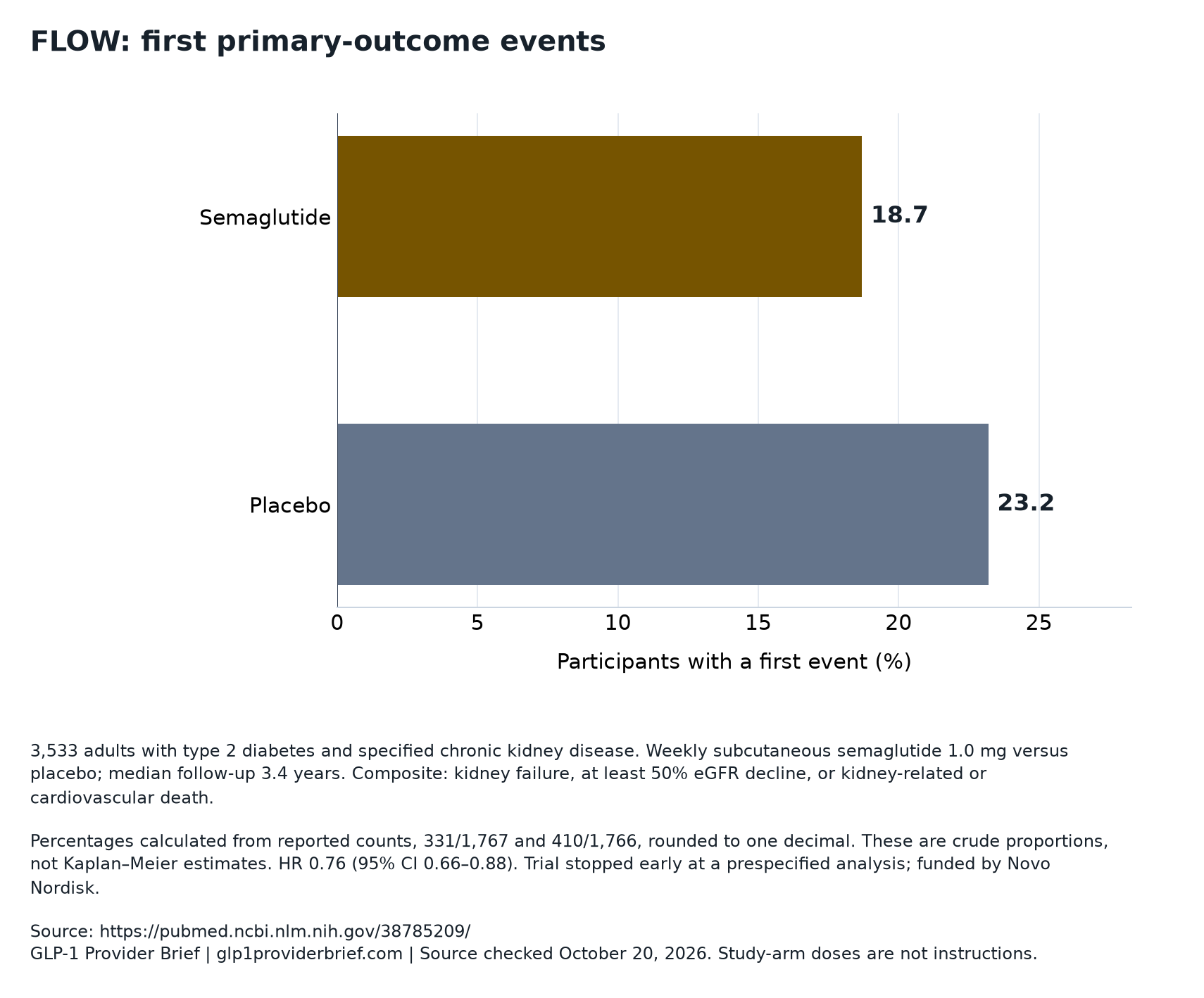
FLOW: first primary-outcome events
3,533 adults with type 2 diabetes and specified chronic kidney disease. Weekly subcutaneous semaglutide 1.0 mg versus placebo; median follow-up 3.4 years. Composite: kidney failure, at least 50% eGFR decline, or kidney-related or cardiovascular death.
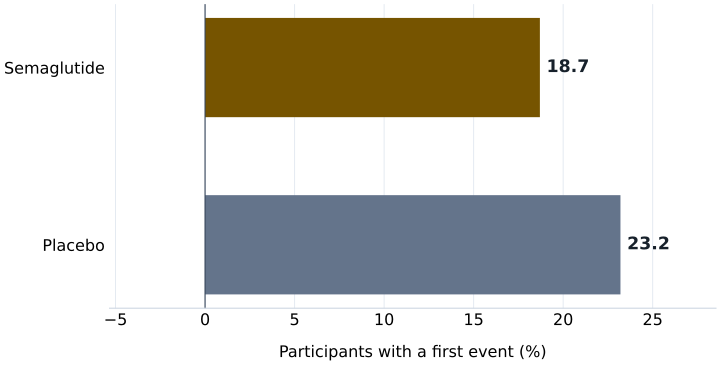
| Study group | Participants with a first event (%) |
|---|---|
| Semaglutide | 18.7 |
| Placebo | 23.2 |
Percentages calculated from reported counts, 331/1,767 and 410/1,766, rounded to one decimal. These are crude proportions, not Kaplan–Meier estimates. HR 0.76 (95% CI 0.66–0.88). Trial stopped early at a prespecified analysis; funded by Novo Nordisk.
Original visualization of published aggregate data. No individual prediction or provider performance is represented. Original research ↗
The main endpoint included cardiovascular death
FLOW’s primary endpoint was a composite: the first occurrence of any qualifying event counted toward the main comparison. Components included kidney failure, at least a 50% reduction in eGFR from baseline, and death from kidney-related or cardiovascular causes. Kidney failure itself included dialysis, transplantation, or an eGFR below 15 mL/min/1.73 m².
Combining events allows investigators to assess several serious consequences within one primary analysis. It also makes the headline less specific than a claim about dialysis alone. A cardiovascular death counted even without a preceding qualifying kidney event. A large eGFR reduction could count without dialysis or transplantation. Thus, describing the result simply as a reduction in kidney failure leaves out important endpoint information.
The abstract also reports a kidney-specific composite, with a hazard ratio of 0.79 and 95% confidence interval of 0.66–0.94, and cardiovascular death separately, with a hazard ratio of 0.71 and interval of 0.56–0.89. These analyses support a signal beyond the broad headline. They still do not show that every individual kidney component improved, or provide a separate dialysis estimate.
| Measure | What it captures | What it does not establish |
|---|---|---|
| Primary composite | First qualifying major kidney event or kidney-related/cardiovascular death | An identical benefit for every component |
| Kidney-specific composite | The kidney-specific components of the primary endpoint | A separate effect estimate for dialysis alone |
| Annual eGFR slope | Average rate of change in estimated filtering function | Guaranteed avoidance of kidney failure |
Reading the 24% result without changing its meaning
There were 331 first primary-outcome events in the semaglutide group and 410 in the placebo group. The reported hazard ratio was 0.76, with a 95% confidence interval of 0.66–0.88. The headline 24% reduction comes from subtracting 0.76 from 1. More precisely, it describes a lower estimated hazard during follow-up, not a 24-percentage-point reduction in the proportion experiencing events.
Simple division gives observed event proportions of about 18.7% and 23.2%, a difference of roughly 4.5 percentage points. This is useful numerical orientation, but it is not a substitute for the trial’s time-to-event analysis. The hazard ratio incorporates when events occur and how long participants are observed. The crude proportions do not fully represent those timing and follow-up features.
The confidence interval is consistent with a relative hazard reduction ranging from approximately 12% to 34% for the primary composite. It describes statistical uncertainty around the estimated treatment comparison, not a range of protection promised to each person. An individual could still experience a qualifying event while receiving semaglutide, and the average trial result cannot identify in advance who will benefit.
Slower eGFR decline is not the same as avoiding dialysis
The mean annual eGFR slope was less steep with semaglutide by 1.16 mL/min/1.73 m². A slope summarizes the rate at which estimated filtering function changes over time. A less negative slope indicates slower average decline; it does not necessarily mean that kidney function increased. The abstract reports this difference as statistically significant but does not supply its confidence interval.
Slope and kidney failure are related but distinct measurements. Kidney failure is a clinical threshold or treatment event, while slope describes a trajectory across repeated measurements. Two people could have similar annual declines yet reach a failure threshold at different times because they began with different kidney function. Conversely, an average slope advantage does not mean every treated participant had slower decline.
A tempting calculation would multiply 1.16 by an assumed number of future years to predict function preserved. That would be an extrapolation, not an observed FLOW result: decline may not remain linear, treatment exposure may change, and individual trajectories vary. The abstract supports slower average loss during the study, not a promised number of dialysis-free years or evidence of kidney regeneration.
The secondary outcomes formed a planned sequence
FLOW used hierarchical testing for prespecified confirmatory secondary outcomes. In plain language, these outcomes were assessed in a planned sequence rather than treated as an unlimited collection of independent chances to find a favorable result. Such an approach helps address the statistical problem that testing many outcomes can produce apparently positive findings by chance.
The abstract reports that all confirmatory secondary outcomes favored semaglutide. Alongside the eGFR-slope result, major cardiovascular events had a hazard ratio of 0.82, with a 95% confidence interval of 0.68–0.98. Death from any cause had a hazard ratio of 0.80, with an interval of 0.67–0.95. These correspond to estimated relative hazard reductions of 18% and 20%, respectively.
These outcomes add clinical depth, but they cannot be added together as if each represented a separate group of beneficiaries. A participant’s cardiovascular event and later death may contribute to different analyses. Nor should cardiovascular death within the primary composite be confused with the broader secondary cardiovascular outcome. The abstract identifies hierarchical testing but does not reproduce the complete testing procedure or all supporting analyses.
Early stopping strengthens the timing question
Median follow-up was 3.4 years. Early trial cessation was recommended at a prespecified interim analysis, meaning a planned opportunity to assess accumulating results existed before the final report. A prespecified look differs from simply stopping after noticing an attractive result. Nevertheless, the shorter observation period affects what the trial can tell us.
Stopping when a benefit emerges can sometimes yield a larger effect estimate than longer follow-up would show. That possibility does not establish that FLOW’s estimate was exaggerated. It does mean that the hazard ratio and confidence interval should be interpreted alongside the stopping decision, rather than as a timeless measure of protection. The abstract does not provide enough detail to reconstruct the stopping boundaries.
Longer observation could clarify durability, later kidney-failure events, and less frequent harms. Median follow-up also is not a statement that every participant was followed for exactly 3.4 years. FLOW demonstrates benefit within its observed trial period; it does not establish a lifetime effect or what happens to kidney outcomes after treatment ends.
Fewer serious adverse events does not mean no tolerability burden
Serious adverse events were reported in 49.6% of semaglutide participants and 53.8% of placebo participants, a difference of 4.2 percentage points. This is a meaningful safety observation in a population with substantial underlying disease. However, an overall serious-event measure is not a complete account of treatment burden, and serious events are not necessarily caused by the assigned drug.
The accessible FLOW abstract does not provide a detailed breakdown of common adverse effects, treatment discontinuations, or specific adverse-event categories. Those missing details should not be replaced with assumptions. In particular, fewer serious events overall cannot establish that every adverse effect was less frequent, or that an individual participant would find treatment easy to tolerate.
The distinction is illustrated by SELECT, a different semaglutide trial: adverse events leading to permanent treatment discontinuation occurred in 16.6% with semaglutide versus 8.2% with placebo. Those are SELECT findings, not FLOW findings. They demonstrate why a clinical-benefit endpoint and a tolerability endpoint need separate attention. NIDDK likewise frames treatment decisions around benefits, adverse effects, health history, and other medicines.
FLOW cannot be substituted for other semaglutide trials
SELECT enrolled 17,604 adults aged at least 45 with established cardiovascular disease, a body-mass index of at least 27, and no history of diabetes. It tested weekly subcutaneous semaglutide 2.4 mg against placebo. Its primary endpoint combined cardiovascular death, nonfatal heart attack, and nonfatal stroke. That differs from FLOW in population, dose, and primary clinical question.
SELECT reported a primary cardiovascular hazard ratio of 0.80, with a 95% confidence interval of 0.72–0.90, over mean follow-up of 39.8 months. That result does not supply a missing FLOW subgroup result or prove kidney protection in people without diabetes. Our SELECT analysis examines that separate evidence base; the STEP-HFpEF article offers another setting in which matching the clinical question matters.
Regulatory evidence also needs its own date and scope. The January 2025 FDA Ozempic label includes reducing sustained eGFR decline, end-stage kidney disease, and cardiovascular death in adults with type 2 diabetes and chronic kidney disease. That dated document supports the approval; it is not presented here as the latest complete prescribing information. Neither trial descriptions nor a historical label replace current product-specific prescribing information.
What a written service claim would need to show
Editorial interpretation: a defensible claim should identify FLOW’s population, injectable intervention, comparator, endpoint, and observation period. Documentation should make clear whether a statement describes trial evidence or the service’s own outcomes. A claim that enrollment guarantees kidney protection, prevents dialysis, or reproduces FLOW’s result goes beyond these findings. Our guide to evidence boundaries separates service documentation from clinical proof.
Product identity matters. FDA states that compounded drugs are not approved or reviewed before marketing for safety, effectiveness, or quality, and identifies concerns including dosing errors and semaglutide salt ingredients. Reports alone do not establish event rates or causation. FLOW does not establish equivalence for compounded preparations, oral routes, or other formulations. The product-terms guide explains what written descriptions should distinguish.
Editorial interpretation: commercial promises need separate documentation for the product supplied, clinical responsibilities, exclusions, and financial obligations. A kidney-outcome trial establishes neither insurance coverage nor refund rights. For documentary checks—not evidence that either provider supplies FLOW’s intervention or kidney-specific care—read the CoreAge Rx review or Mochi Health review. The refund-boundaries guide addresses what a financial guarantee actually covers.
Questions & answers
Did FLOW show that semaglutide prevents dialysis?
Dialysis was one way to meet the kidney-failure component, but the primary outcome included several other events. The abstract reports a favorable primary composite and kidney-specific composite, not a separate dialysis effect estimate. It supports reduced major kidney-related risk in the studied population, not guaranteed dialysis prevention.
Does the 24% reduction mean 24 fewer events per 100 people?
No. It is derived from a hazard ratio of 0.76, describing a relative comparison over follow-up. Observed first-event proportions were approximately 18.7% versus 23.2%, about 4.5 percentage points apart. Those crude proportions help explain scale but do not replace the time-to-event estimate.
Can someone without diabetes assume the same kidney benefit?
FLOW cannot directly establish that. All participants had type 2 diabetes and met specific kidney-function and albuminuria criteria. SELECT studied people without diabetes, but its population and primary cardiovascular endpoint were different. Combining the two headlines does not create a randomized kidney-outcome result for an unstudied population.
Do the findings explain how semaglutide protected kidneys?
The randomized comparison supports a treatment effect on the reported outcomes, but the abstract does not establish its biological pathway. It cannot determine how much benefit came through changes in weight, glucose, blood pressure, or other processes. Demonstrating an outcome difference is different from proving the mechanism responsible.
Does a provider’s use of the name semaglutide establish equivalence to FLOW?
No. The studied formulation, route, population, and treatment context matter. FDA says compounded products are not FDA approved and that results for approved products do not establish compounded-product equivalence. A provider also needs its own evidence before attributing trial-level outcomes to its service rather than describing the medication research.
Our assessment
FLOW provides persuasive randomized evidence that weekly injectable semaglutide reduced a composite of major kidney events and kidney-related or cardiovascular death in people with type 2 diabetes and defined chronic kidney disease. The kidney-specific analysis, slower eGFR decline, and confirmatory secondary outcomes reinforce the finding. Its boundaries remain important: early cessation limits longer-term observation, composite results do not establish every component separately, and the accessible abstract supplies incomplete safety detail. Editorial interpretation: a service can accurately explain this evidence, but cannot convert it into a personal outcome guarantee, a compounded-product equivalence claim, or proof that its own care model reproduces the trial.
Sources & documentation
Scientific and official sources consulted October 20, 2026. Study findings apply to the populations, products and time periods described; they are not provider outcome data.
- Effects of Semaglutide on Chronic Kidney Disease in Patients with Type 2 Diabetes. ↗
- Semaglutide and Cardiovascular Outcomes in Obesity without Diabetes. ↗
- NIDDK prescription medications for overweight and obesity ↗
- FDA Ozempic prescribing information, January 2025 kidney indication ↗
- FDA concerns about unapproved GLP-1 drugs ↗