A diabetes-prevention claim needs more than a weight-loss percentage. It needs a defined population, a comparison group, a measured disease outcome, and enough follow-up to show what happened over time. The extended SURMOUNT-1 analysis provides that kind of evidence: among 1,032 participants with obesity and prediabetes, substantially fewer developed type 2 diabetes during 176 weeks of assigned tirzepatide treatment than during placebo treatment. A further 17 weeks without study treatment added an important, but limited, view of what followed.
The practical challenge is separating that clinical finding from broader promises. Preventing or delaying a diagnosis during a trial is not the same as eliminating future diabetes risk, and a drug trial does not validate a particular service or formulation. This analysis uses the indexed primary report abstracts and available official NIDDK and FDA material; it does not represent a review of the complete articles, protocols, or supplements.
At a glance
- Population followed
- The extended analysis involved 1,032 SURMOUNT-1 participants with both obesity and prediabetes, drawn from the original 2,539-participant trial.Sources: [2]
- Diabetes through week 176
- Type 2 diabetes was diagnosed in 1.3% of pooled tirzepatide participants versus 13.3% of placebo participants—a 12.0-percentage-point difference.Sources: [2]
- After 17 weeks off treatment
- By week 193, the reported proportions with diabetes were 2.4% versus 13.7%; the hazard ratio was 0.12, with a 95% confidence interval of 0.1–0.2.Sources: [2]
- Weight findings by dose
- Mean weight changes at week 176 were −12.3%, −18.7%, and −19.7% in the 5-, 10-, and 15-mg tirzepatide arms, respectively, versus −1.3% with placebo.Sources: [2]
- Safety findings
- Gastrointestinal adverse events were common, mostly mild to moderate, and concentrated during dose escalation. The extended report identified no new safety signals.Sources: [2]
Who entered the trial—and who supplied the three-year evidence
The original SURMOUNT-1 study was a phase 3, randomized, double-blind, placebo-controlled trial involving 2,539 adults without diabetes. Eligibility included a body mass index of at least 30, or at least 27 with a weight-related complication. Body mass index relates weight to height; it is an enrollment measure, not a complete description of metabolic health. Participants were assigned equally among three tirzepatide groups and placebo.
The three-year analysis addressed a narrower population: the 1,032 participants who had both obesity and prediabetes. Prediabetes describes glucose regulation that is abnormal but does not meet diagnostic criteria for diabetes. This group is particularly relevant to progression research, but its results should not be presented as an estimate for everyone seeking weight treatment.
The original trial's average body weight of 104.8 kilograms and average body mass index of 38.0 describe the full study population, not necessarily the extended-analysis subgroup. Keeping those populations separate prevents an easy reporting error: attaching baseline characteristics from all 2,539 participants to the 1,032 whose diabetes outcomes are discussed here.
What was compared over 176 weeks
Participants received tirzepatide by once-weekly subcutaneous injection—an injection under the skin—or placebo. The assigned tirzepatide doses were 5, 10, and 15 milligrams. These identify research arms, not dosing instructions. The original trial included a 20-week dose-escalation period, and the extended report describes gastrointestinal effects as occurring primarily during that early escalation period.
Random assignment helps separate treatment effects from differences that might otherwise influence outcomes, such as starting health or motivation. Double blinding means participants and study personnel were not told the assigned treatment. Placebo supplies the comparison needed to judge whether outcomes differ beyond changes occurring without the active study drug.
The prediabetes analysis followed assigned treatment for 176 weeks and then added 17 weeks off treatment, reaching week 193. Its three key secondary endpoints were weight change at week 176 and onset of diabetes through weeks 176 and 193. These were controlled for type I error, meaning the statistical plan addressed false-positive findings across those tests. They were not the original trial's coprimary weight endpoints.
| Feature | Original report | Extended prediabetes report |
|---|---|---|
| Analysis population | 2,539 adults without diabetes | 1,032 participants with obesity and prediabetes |
| Observation window | 72 weeks | 176 weeks of treatment plus 17 weeks off treatment |
| Main outcomes described | Coprimary weight-change and ≥5% weight-loss endpoints | Key secondary weight-change and diabetes-onset endpoints |
| Diabetes estimate used here | Not the three-year progression analysis | Pooled tirzepatide groups versus placebo |
STUDY DATA · GLP-1 Provider Brief
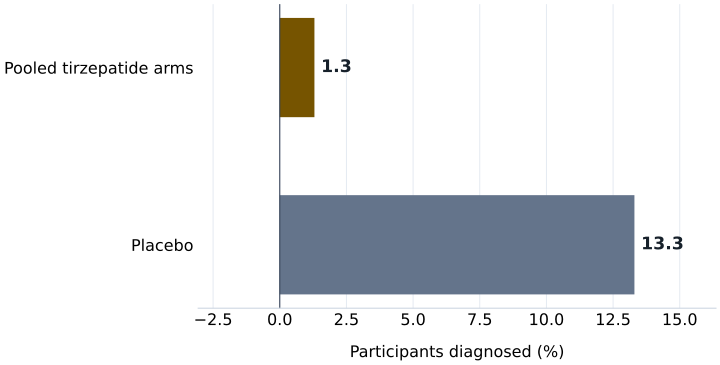
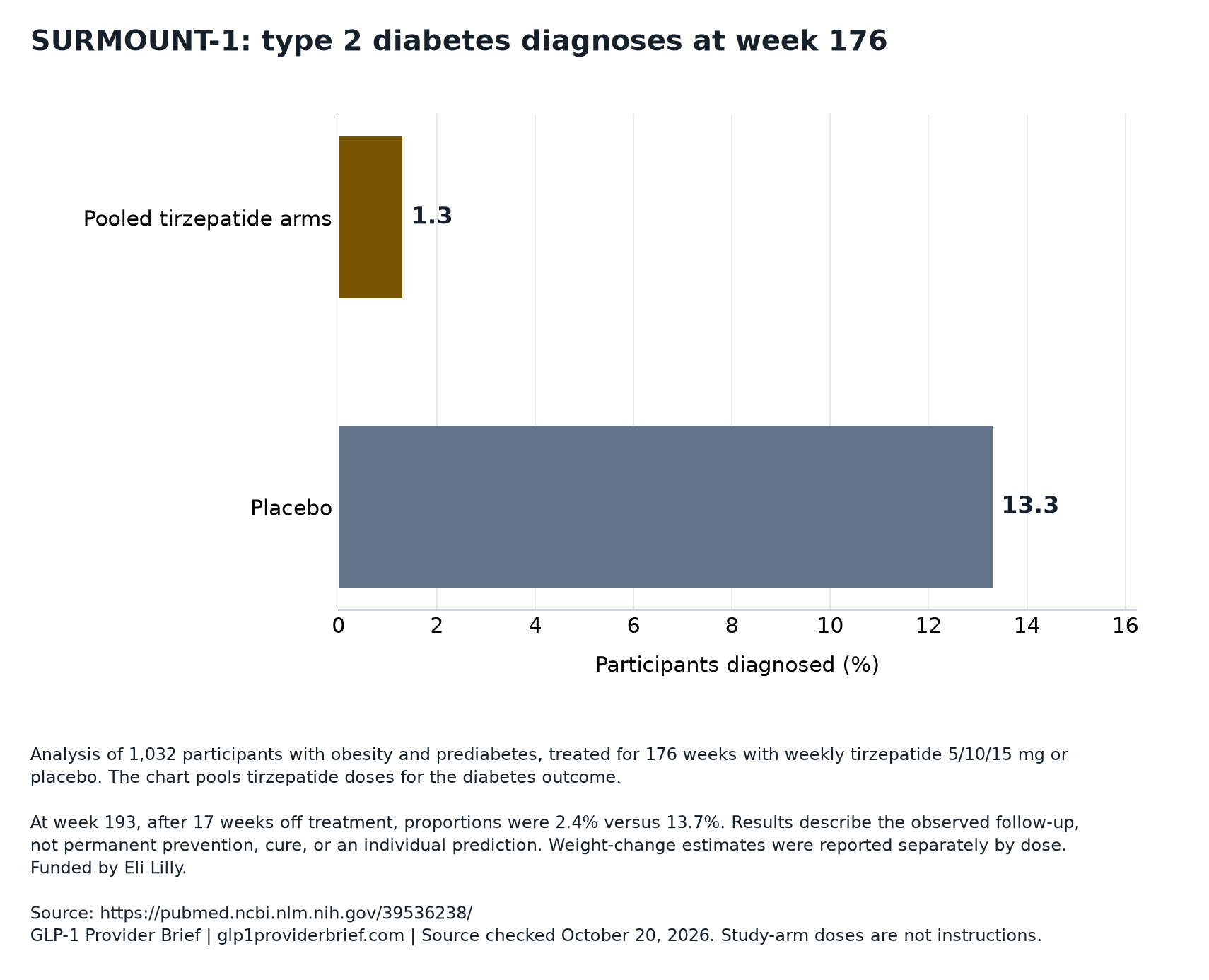
SURMOUNT-1: type 2 diabetes diagnoses at week 176
Analysis of 1,032 participants with obesity and prediabetes, treated for 176 weeks with weekly tirzepatide 5/10/15 mg or placebo. The chart pools tirzepatide doses for the diabetes outcome.
| Study group | Participants diagnosed (%) |
|---|---|
| Pooled tirzepatide arms | 1.3 |
| Placebo | 13.3 |
At week 193, after 17 weeks off treatment, proportions were 2.4% versus 13.7%. Results describe the observed follow-up, not permanent prevention, cure, or an individual prediction. Weight-change estimates were reported separately by dose. Funded by Eli Lilly.
Original visualization of published aggregate data. No individual prediction or provider performance is represented. Original research ↗
Reading 1.3% versus 13.3% without inflating the result
Through week 176, 1.3% of participants in the pooled tirzepatide groups received a type 2 diabetes diagnosis, compared with 13.3% in the placebo group. Subtracting those reported percentages gives an absolute difference of 12.0 percentage points. Expressed on a common scale, the reported proportions correspond to about 13 versus 133 diagnoses per 1,000 participants; these are scaled percentages, not the trial's raw event counts.
The report also gives a hazard ratio of 0.07, with a 95% confidence interval of 0.0–0.1. A hazard ratio summarizes relative event occurrence over follow-up, incorporating timing; it is not the same calculation as dividing the final percentages. The estimate corresponds to a 93% lower hazard, not a 93-percentage-point reduction in diabetes.
The displayed confidence interval is coarsely rounded. Its lower bound of 0.0 should not be read as proof that the true hazard could literally be zero, nor should additional decimal places be invented. The central finding is a large separation favoring tirzepatide, with statistical uncertainty around its exact size. Some treated participants still developed diabetes, so the result cannot support universal protection.
Weight results were dose-specific; the diabetes estimate was pooled
At week 176, average weight change was −12.3% with 5 milligrams, −18.7% with 10 milligrams, and −19.7% with 15 milligrams, compared with −1.3% for placebo. Those are changes from starting weight, not percentages of participants who reached a target. The placebo-adjusted differences calculated from these means are 11.0, 17.4, and 18.4 percentage points of body weight.
The extended abstract does not provide confidence intervals for these weight estimates. It reports that each comparison with placebo was statistically significant, but it does not establish from those comparisons alone whether the two higher-dose arms differed meaningfully from each other. A larger numerical average is not automatically a proven head-to-head advantage.
More importantly, the 1.3% diabetes figure combines the tirzepatide groups. It cannot be assigned separately to every dose, and the abstract does not show a dose-specific diabetes-prevention gradient. The earlier 72-week weight results also came from a broader population and different follow-up. Comparing those averages directly with the three-year subgroup averages would not establish how much weight individual participants regained.
| Measure | Reported result | Interpretation boundary |
|---|---|---|
| Week-176 weight change, 5 mg | −12.3% | An arm-level mean, not a personal forecast |
| Week-176 weight change, 10 mg | −18.7% | Not a dose-specific diabetes estimate |
| Week-176 weight change, 15 mg | −19.7% | Does not alone prove superiority to 10 mg |
| Week-176 weight change, placebo | −1.3% | Comparator for the weight findings |
| Diabetes through week 176 | 1.3% pooled tirzepatide versus 13.3% placebo | Cannot be attributed separately to each dose |
The off-treatment period shows persistence, not permanence
After 17 weeks off assigned treatment or placebo, the reported proportions with diabetes were 2.4% and 13.7%, respectively. The absolute difference was therefore 11.3 percentage points. The hazard ratio through this longer period was 0.12, with a 95% confidence interval of 0.1–0.2, indicating that a substantial separation remained through week 193.
Those week-193 percentages are cumulative outcomes, not the incidence during the off-treatment interval alone. The tirzepatide figure rose by 1.1 percentage points from the week-176 figure, while placebo rose by 0.4 points. These changes should not be converted into a precise post-withdrawal hazard: the abstract does not provide the interval-specific analysis and population accounting needed for that calculation.
Seventeen weeks is short relative to the years over which diabetes can develop. The extension therefore supports persistence of a benefit over a limited observation window, not lifelong protection. Whether treatment permanently prevents some cases, mainly postpones diagnosis, or does both in different people remains unresolved. A promise that diabetes risk disappears after a finite course goes beyond these data.
A diabetes endpoint is stronger than a mechanism story
Tirzepatide acts at receptors for glucose-dependent insulinotropic polypeptide and glucagon-like peptide-1, often abbreviated GIP and GLP-1. The important clinical observation here is not simply that the drug affects pathways involved in metabolism: fewer participants met the study's diabetes outcome during follow-up. That is more directly relevant to progression than weight change alone.
Nevertheless, randomizing a medicine does not separately randomize every downstream change it produces. These abstracts do not quantify how much of the diabetes difference was mediated by weight loss, by effects on glucose regulation, or by other changes. A plausible biological explanation is not a measured allocation of causality among those pathways.
The outcome also has a defined boundary. This analysis does not establish reductions in kidney failure, heart attacks, or every future diabetes complication. The separate questions explored in SELECT cardiovascular outcomes and FLOW kidney outcomes illustrate why clinical endpoints must be checked individually. A result for diabetes onset cannot substitute for evidence on another disease outcome.
Tolerability matters alongside prevention
In the extended report, gastrointestinal events were the most common adverse events other than COVID-19. Most were mild to moderate and occurred primarily during dose escalation in the first 20 weeks. The report identified no new safety signals. That means no newly recognized pattern was identified in this analysis; it does not mean adverse effects were absent.
The original 72-week SURMOUNT-1 report supplies a concrete measure of treatment burden: adverse events led to treatment discontinuation in 4.3%, 7.1%, and 6.2% of participants assigned to 5, 10, and 15 milligrams, respectively, versus 2.6% with placebo. These are findings from the original population and period, not three-year discontinuation rates for the prediabetes subgroup.
The extended abstract does not supply a detailed adverse-event table, subgroup-specific discontinuation figures, or estimates for every uncommon harm. Consequently, its reassuring signal assessment cannot establish the absence of rare risks. NIDDK's official guidance places treatment decisions in the context of health history, other medicines, benefits, adverse effects, and cost rather than a single efficacy percentage.
Maintenance research answers a different question
SURMOUNT-MAINTAIN should not be confused with the extended SURMOUNT-1 diabetes analysis. In MAINTAIN, participants first underwent 60 weeks of open-label tirzepatide treatment. Then 378 were randomized to continue their maximum tolerated dose, reduce to 5 milligrams, or switch to placebo for another 52 weeks. The primary endpoint was weight change, not three-year diabetes incidence.
Estimated weight changes from the original baseline to week 112 were −21.9%, −16.6%, and −9.9%, respectively. Their 95% confidence intervals were −23.5 to −20.3, −18.0 to −15.1, and −11.1 to −8.8. Rescue treatment was permitted under specified weight-regain conditions, and the primary analysis used assumptions addressing rescue. These design features matter when interpreting maintenance outcomes.
MAINTAIN supports the importance of continued treatment for maintaining weight reduction in its studied population. It does not establish which maintenance strategy preserves SURMOUNT-1's diabetes benefit. Likewise, the SURMOUNT-4 withdrawal analysis addresses a related but distinct research question. Neither study should be turned into an individualized dose-reduction or stopping plan.
Where the evidence remains incomplete
Randomization and lengthy treatment strengthen the diabetes finding, but generalizability still depends on who was studied. Adults with obesity and prediabetes are not interchangeable with people who have normal glucose regulation, established diabetes, or substantially different clinical characteristics. The extended abstract does not provide enough demographic or subgroup detail to estimate effects reliably across every age, racial, or baseline-risk group.
Important methodological details also remain outside the accessible abstract: the full diagnostic confirmation procedures, visit-level glucose data, retention patterns, and sensitivity analyses for missing observations. Their absence from this analysis is not evidence that the trial lacked them. It limits how independently the reported diabetes estimates and their robustness can be assessed here.
Eli Lilly funded both SURMOUNT-1 reports and SURMOUNT-MAINTAIN. Sponsorship does not negate randomized findings, but it belongs in an assessment of the evidence. The strongest supported conclusion remains specific: substantially fewer diabetes diagnoses occurred with assigned tirzepatide than placebo in this population over the reported period. Longer off-treatment observation is needed to resolve durability beyond that window.
What a service can legitimately say in writing
A defensible claim would name the population, injected treatment, placebo comparison, pooled diabetes estimate, and follow-up. It could explain that treatment markedly reduced progression during the trial. A guarantee that a customer will avoid diabetes, remain protected after stopping, or reproduce the study average is not supported. Trial results also are not current prescribing information or proof of a prevention-specific regulatory indication.
Formulation identity is essential. FDA states that compounded drugs are not FDA approved or reviewed before marketing for safety, effectiveness, or quality. These trial findings do not establish equivalence for compounded preparations, oral products, or another formulation. The product-terms guide explains the documentary distinction, while evidence boundaries separates clear contracts from demonstrated clinical outcomes.
Editorial interpretation: a service invoking long-term prevention should make product identity, monitoring responsibilities, recurring charges, and exit terms understandable in writing. That is a documentation standard, not a claim that any service reproduces trial care. The billing-commitments guide and CoreAge Rx contract review can help frame documentary questions; neither link establishes availability of the studied treatment or diabetes-prevention outcomes.
Questions & answers
Does SURMOUNT-1 show that tirzepatide cures prediabetes?
No. It shows a substantially lower occurrence of type 2 diabetes during the reported follow-up among participants with obesity and prediabetes. A cure would imply a durable resolution that these observations cannot establish. Diabetes still occurred in some treated participants, and the off-treatment period lasted only 17 weeks.
Can the 1.3% diabetes figure be used to compare the three doses?
No. That figure pools the tirzepatide groups. Weight outcomes were reported separately for 5, 10, and 15 milligrams, but the abstract does not provide corresponding dose-specific diabetes estimates. Using the pooled percentage as proof that each dose gives identical protection—or that one gives superior protection—would exceed the evidence.
Why is a 93% lower hazard not the same as a 93% lower personal risk?
The hazard ratio summarizes relative event occurrence over time in trial groups. It is not an individualized forecast. The reported week-176 proportions differed by 12.0 percentage points, while the hazard ratio was 0.07. Both describe the study result, but they answer different numerical questions and cannot determine one person's outcome.
Does the off-treatment result mean treatment can be stopped without losing protection?
It shows that a substantial difference remained through 17 weeks off treatment, not that protection is permanent. The proportion diagnosed with diabetes increased during the longer observation window. Neither that short extension nor a separate weight-maintenance trial establishes an individual stopping strategy or the duration of benefit after treatment ends.
What evidence should accompany an advertised diabetes-prevention promise?
Look for the named study, eligible population, exact formulation and route, comparator, follow-up, and whether results combine doses. A service should distinguish trial findings from its own documented outcomes and written financial promises. FDA's cautions mean a compounded product cannot be assumed equivalent merely because it uses a related ingredient name.
Our assessment
SURMOUNT-1 offers substantial randomized evidence that tirzepatide reduced progression to type 2 diabetes over approximately three years in adults with obesity and prediabetes. The size of the placebo comparison makes this more than a weight-loss story. Its boundaries are equally important: diabetes estimates pooled doses, safety included real tolerability burdens, and only 17 weeks of off-treatment follow-up were reported. The legitimate service claim is evidence of reduced or delayed progression in a defined trial population—not a cure, permanent immunity, formulation equivalence, insurance promise, or guaranteed customer outcome.
Sources & documentation
Scientific and official sources consulted October 20, 2026. Study findings apply to the populations, products and time periods described; they are not provider outcome data.
- Tirzepatide Once Weekly for the Treatment of Obesity. ↗
- Tirzepatide for Obesity Treatment and Diabetes Prevention. ↗
- NIDDK prescription medications for overweight and obesity ↗
- Tirzepatide for maintenance of bodyweight reduction in people with obesity in the USA (SURMOUNT-MAINTAIN): a multicentre, double-blind, randomised, placebo-controlled trial. ↗
- FDA concerns about unapproved GLP-1 drugs ↗