A weight-loss service can cite an impressive clinical trial without proving that its own maintenance program delivers the same result. SURMOUNT-4 provides an especially important example: people who continued tirzepatide after an initial treatment period maintained and extended substantial weight loss, while those switched to placebo regained weight on average. Understanding that finding requires separating the people who entered treatment from those later randomized, and separating percentages measured from two different starting weights.
The evidence has also moved beyond a simple continue-or-stop question. The 2026 SURMOUNT-MAINTAIN report tested a lower-dose maintenance arm alongside continued maximum tolerated treatment and placebo. Together, these studies support ongoing treatment as an effective maintenance strategy for many participants, not a universal promise or a contract requirement. This analysis uses the indexed primary report abstracts for the tirzepatide trials, the accessible full STEP 1 extension article, and official NIDDK and FDA material; it does not represent a review of every protocol or supplement.
At a glance
- Entry is not randomization
- SURMOUNT-4 enrolled 783 adults into a 36-week tirzepatide lead-in; 670 were subsequently randomized, 335 to continued tirzepatide and 335 to placebo.Sources: [1]
- Two different weight baselines
- The randomized group lost a mean 20.9% during the lead-in. From week 36 to week 88, weight changed by −5.5% with continued tirzepatide versus +14.0% with placebo.Sources: [1]
- Maintenance threshold
- At week 88, 89.5% continuing tirzepatide maintained at least 80% of their initial weight loss, compared with 16.6% switched to placebo.Sources: [1]
- Lower-dose research exists
- SURMOUNT-MAINTAIN randomized 378 participants after a 60-week weight-loss period to continued maximum tolerated tirzepatide, a 5 mg arm, or placebo for another 52 weeks.Sources: [3]
- Product equivalence is not established
- FDA states that compounded drugs are not FDA approved or reviewed before marketing for safety, effectiveness, or quality; trial results do not establish equivalence for compounded preparations.Sources: [5]
SURMOUNT-4 randomized a decision after treatment had already worked
SURMOUNT-4 was a phase 3 randomized withdrawal trial at 70 sites in four countries. Eligible adults had a body mass index, or BMI, of at least 30, or at least 27 with a weight-related complication. Diabetes was excluded. Everyone entering the initial phase received once-weekly subcutaneous tirzepatide, meaning an injection under the skin, with diet and physical activity. The studied maximum tolerated doses were 10 or 15 mg; these identify trial arms, not instructions for treatment.
The first 36 weeks were open-label: participants and investigators knew tirzepatide was being used. Only then were 670 participants assigned equally to continue tirzepatide or switch to placebo for 52 weeks. This second phase was double-blind, with treatment assignment concealed. Randomizing at that point creates a direct test of continuation versus withdrawal among people who reached the maintenance decision.
That is different from asking what happens to everyone starting a prescription. The randomized participants had a mean age of 48 years, 71% were women, and the report gives a mean weight of 107.3 kg. The trial is most informative about a selected, treatment-experienced population, rather than all prospective service customers.
Why the difference between 783 and 670 matters
Of 783 adults entering the lead-in, 670 reached randomization: about 86%, leaving 113 outside the randomized comparison. The indexed abstract does not give a complete breakdown of why those individuals did not proceed. It would therefore be incorrect to label all 113 as adverse-effect withdrawals, treatment failures, or administrative losses.
The important design consequence is selection. Maintenance participants had completed a substantial period of treatment and reached a maximum tolerated study dose. They were selected tolerators and completers, not an unfiltered sample of everyone who might try tirzepatide. Their 20.9% average lead-in loss describes this randomized population, not a guaranteed starting-treatment outcome for all 783 entrants.
Selection does not erase the randomized result. Within the group that reached week 36, random assignment supports a strong causal comparison between continuing treatment and switching to placebo. It does narrow the question being answered. A service claim about every new enrollee needs evidence that includes early discontinuation, inadequate response, and inability to tolerate treatment—not just outcomes among people who successfully reach maintenance.
STUDY DATA · GLP-1 Provider Brief
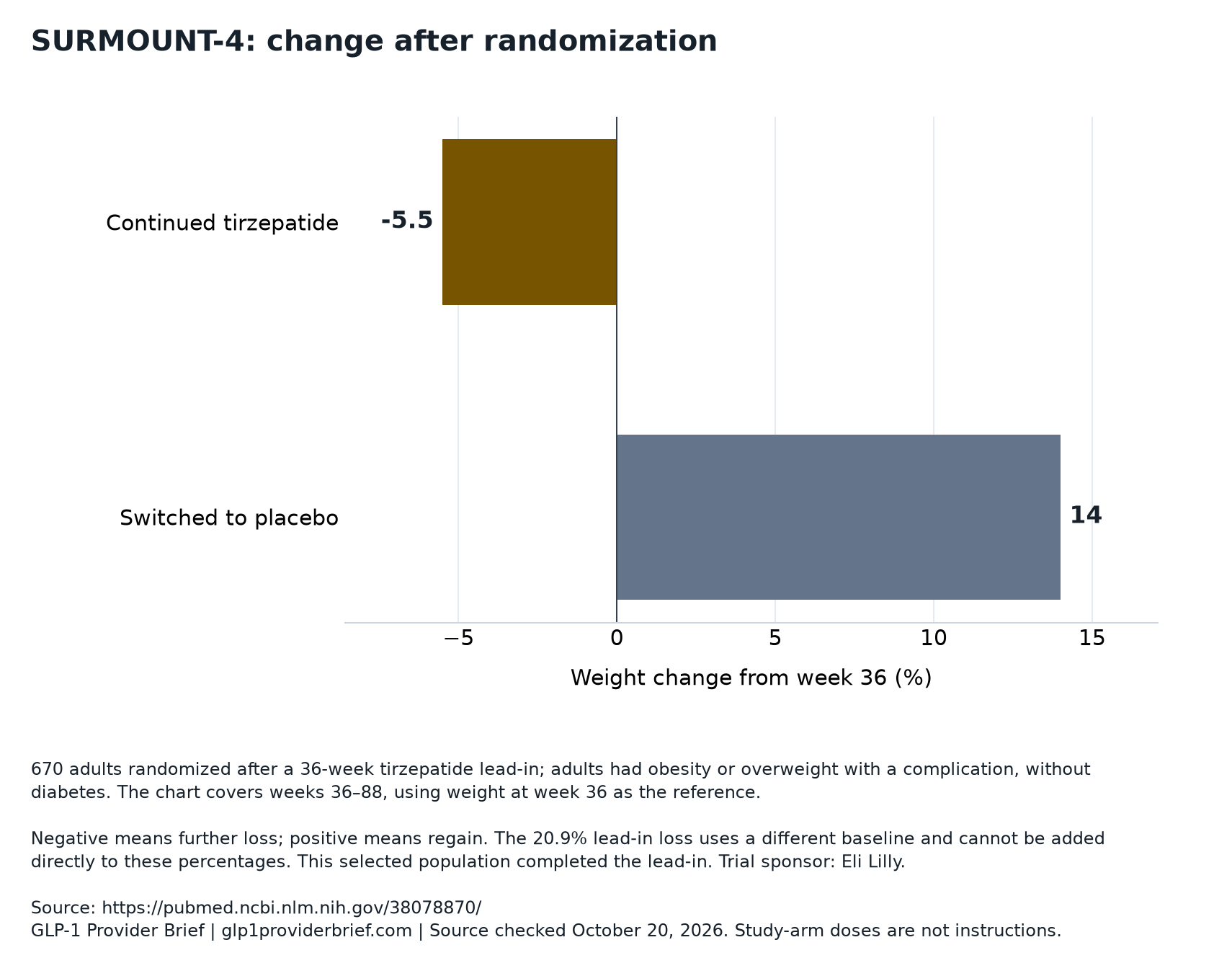
SURMOUNT-4: change after randomization
670 adults randomized after a 36-week tirzepatide lead-in; adults had obesity or overweight with a complication, without diabetes. The chart covers weeks 36–88, using weight at week 36 as the reference.
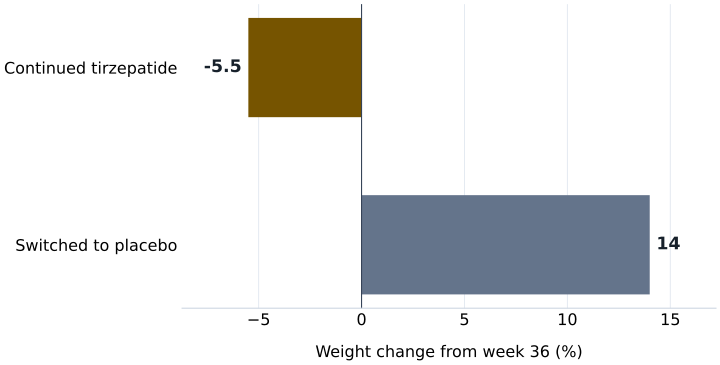
| Study group | Weight change from week 36 (%) |
|---|---|
| Continued tirzepatide | -5.5 |
| Switched to placebo | 14 |
Negative means further loss; positive means regain. The 20.9% lead-in loss uses a different baseline and cannot be added directly to these percentages. This selected population completed the lead-in. Trial sponsor: Eli Lilly.
Original visualization of published aggregate data. No individual prediction or provider performance is represented. Original research ↗
The percentage arithmetic behind loss and regain
The primary endpoint was mean percentage weight change from week 36 to week 88. Continued tirzepatide produced a further 5.5% reduction, while placebo produced a 14.0% increase. The reported between-group difference was −19.4 percentage points, with a 95% confidence interval from −21.2 to −17.7. This is a difference in weight-change percentages, not a relative reduction in the risk of gaining weight.
A worked illustration clarifies the denominator. Imagine an initial weight of 100 arbitrary units. A 20.9% loss leaves 79.1 units at week 36. A subsequent 14.0% increase is calculated from 79.1, adding about 11.1 units—not 14 units of the original weight. A further 5.5% decrease similarly subtracts about 4.4 units. This is illustrative arithmetic, not an individual forecast or a reconstruction of the statistical model.
The reported overall losses from week 0 to week 88 were 25.3% with continued tirzepatide and 9.9% after switching to placebo. Thus, substantial regain did not mean that the placebo group, on average, exceeded its original weight. Nor can the rounded phase-specific percentages simply be added or subtracted as though they share one denominator.
| Measure | Continued tirzepatide | Switched to placebo |
|---|---|---|
| Randomized participants | 335 | 335 |
| Week 36–88 mean weight change, relative to week 36 | −5.5% | +14.0% |
| Reported between-group difference | −19.4 percentage points; 95% CI −21.2 to −17.7 | Reference group |
| Maintained at least 80% of lead-in loss at week 88 | 89.5% | 16.6% |
| Week 0–88 overall mean weight reduction | 25.3% | 9.9% |
Maintaining 80% of a loss is not the same as never regaining
The key maintenance endpoint counted participants who retained at least 80% of the weight they had lost during the lead-in. For someone who initially lost 20 weight units, that threshold would mean retaining at least 16 units of loss. Some regain could therefore occur while the person still met the study’s maintenance definition.
At week 88, 300 participants continuing tirzepatide, or 89.5%, met that threshold, compared with 16.6% receiving placebo. The absolute difference was 72.9 percentage points. This categorical result complements the average weight changes: it shows that the continuation advantage was not expressed only as a difference between two group means.
It still does not establish that every continuing participant maintained all their loss, or that every participant withdrawing treatment regained it. The confidence interval for the primary mean difference describes uncertainty around the group comparison, not the range of individual outcomes. Readers comparing withdrawal evidence can find the separate STEP 1 extension analysis, whose endpoint and design should not be treated as interchangeable with this randomized maintenance comparison.
SURMOUNT-MAINTAIN tested an additional maintenance strategy
It is no longer accurate to say that maintenance-dose reduction has not been studied. SURMOUNT-MAINTAIN was a 112-week phase 3b trial at 20 US sites. It enrolled 441 adults into a 60-week open-label weight-loss period using weekly subcutaneous tirzepatide at a maximum tolerated dose of 10 or 15 mg. At week 60, 378 participants were randomized: 140 continued that dose, 144 entered a 5 mg arm, and 94 switched to placebo.
Eligibility included BMI of at least 30, or at least 27 with a weight-related condition, and at least one self-reported unsuccessful dietary weight-loss effort. The enrolled population had a mean age of 46.6 years, mean weight of 113.8 kg, and mean BMI of 40.1; 65% were female and 67% were White. These characteristics help define the population behind the averages.
After another 52 weeks, model-based weight changes from the original baseline were −21.9% with continued maximum tolerated treatment, −16.6% in the 5 mg arm, and −9.9% with placebo. Those are total 112-week changes, not additional losses after randomization. The pattern supports a lower-dose strategy as an evidence-based research finding, while showing less retained average weight reduction than continued maximum tolerated treatment.
| Randomized maintenance arm | Weight change from original baseline, with 95% CI | Observed rescue-treatment use |
|---|---|---|
| Maximum tolerated tirzepatide | −21.9% (−23.5 to −20.3) | 11/138, or 8% |
| Tirzepatide 5 mg | −16.6% (−18.0 to −15.1) | 35/142, or 25% |
| Placebo | −9.9% (−11.1 to −8.8) | 60/90, or 67% |
Rescue treatment changes how the newer results should be read
Beginning at week 84, 24 weeks after randomization, SURMOUNT-MAINTAIN allowed rescue tirzepatide when regain exceeded 50% of previously lost weight. The observed rescue-treatment proportions were 8%, 25%, and 67% in the maximum tolerated, 5 mg, and placebo arms, respectively. The denominators in that report differ from the original randomized group sizes, so those figures should retain their stated denominators.
The primary analysis used a modified treatment-regimen estimand. An estimand is the precise treatment effect a statistical analysis aims to measure, including how it handles events such as treatment discontinuation or rescue. Here, all randomized participants were included regardless of discontinuation or prohibited medication use, with an assumption that those initiating rescue would gain no further benefit from their assigned study treatment. The results are therefore not simply untreated observations after rescue.
Compared with placebo, estimated differences were −12.0 percentage points for maximum tolerated treatment and −6.6 for the 5 mg arm. The latter had a 95% confidence interval of −8.3 to −5.0; the former interval was approximately −13.8 to −10.1, although its indexed rendering contains a typographical artifact. Overall study completion was 345 of 378, or 91%. Eli Lilly funded this trial.
Safety findings must be read alongside the selected population
In SURMOUNT-4, the most common adverse events were gastrointestinal, mostly mild to moderate, and occurred more often with tirzepatide than placebo. The indexed abstract does not provide event-specific rates or a detailed serious-adverse-event comparison. It supports reporting a real tolerability burden, but not calculating a precise excess rate for a particular symptom.
SURMOUNT-MAINTAIN likewise reported gastrointestinal events as the most common adverse events with tirzepatide. They were mostly mild to moderate and occurred mainly during dose escalation. Its maintenance safety population included 372 participants receiving at least one maintenance-period dose: 139, 142, and 91 across the three arms. Neither abstract supports a blanket assertion that maintenance is free of important risks.
Both trials began maintenance comparisons after lengthy exposure, which matters when interpreting tolerability for new starters. The evidence also does not identify the best strategy for every individual, establish a tapering schedule, or compare all possible formulations. A direct-comparison trial addresses a different question from withdrawal; treatment rankings elsewhere cannot supply missing maintenance safety data here.
Semaglutide withdrawal provides context, not a head-to-head verdict
The STEP 1 extension followed 327 participants from a much larger semaglutide trial. The original trial randomized 1,961 adults without diabetes to weekly subcutaneous semaglutide 2.4 mg or placebo for 68 weeks. At treatment completion, medication and structured lifestyle intervention stopped. The extension then observed a selected subset for another year; its analyses were exploratory, rather than a newly randomized continuation-versus-withdrawal experiment.
In that subset, mean weight loss during treatment was 17.3% with semaglutide and 2.0% with placebo. By week 120, the former semaglutide group had regained 11.6 percentage points relative to original baseline, leaving a reported net loss of 5.6%. The standard deviations—9.3% for initial loss and 7.7 percentage points for regain—show substantial variability. The familiar description of two-thirds regained summarizes a group average, not everyone’s trajectory.
Most cardiometabolic measures moved back toward baseline, but not every improvement disappeared. Systolic blood pressure averaged 129, 121, and 131 mm Hg at baseline, week 68, and week 120, while some lipid and inflammatory measures retained improvement. These are risk-factor observations, not proof of changes in heart attacks or survival. The extension, funded by Novo Nordisk, did not systematically collect adverse events and cannot isolate medication withdrawal from withdrawal of structured lifestyle support.
A provider’s maintenance claim needs its own documentation
A defensible clinical statement is that continued tirzepatide outperformed withdrawal for maintaining weight reduction in the studied populations. A stronger statement—that a particular service guarantees comparable maintenance—requires service-specific evidence. Documentation should identify the product, route, population, follow-up period, maintenance definition, and handling of people who leave care. Excluding unsuccessful participants can make commercial outcome summaries look more favorable than an all-enrollee analysis.
Editorial interpretation: a clinical maintenance benefit does not establish that a long prepaid commitment is medically necessary, that coverage will continue, or that a refund promise is easy to use. Those are separate documentary questions. The billing commitments guide and refund boundaries guide explain how to distinguish duration, eligibility conditions, and financial remedies from treatment outcomes.
Readers considering a named service can use the Mochi Health review to check documentary terms, not as evidence that the provider supplies the studied product or achieves these results. A legitimate guarantee should state exactly what is guaranteed—money, access, or a measured outcome—and what happens when treatment is unsuitable or interrupted. Randomization in a drug trial validates none of those contractual promises.
Product identity and follow-up set the evidence boundary
The studied injection regimens cannot automatically validate compounded preparations, oral routes, other formulations, or a platform’s care model. FDA states that compounded drugs are not FDA approved and are not reviewed before marketing for safety, effectiveness, or quality. It recommends compounded products only when a patient’s needs cannot be met by an FDA-approved drug. Its concerns include dosing errors and semaglutide salt ingredients; adverse-event reports alone do not establish incidence or causation.
The practical documentary question is therefore what product a service actually proposes, not merely whether its marketing mentions tirzepatide research. The product terms guide separates formulation descriptions from evidence claims. This distinction does not require assuming that every preparation has the same problem; it requires recognizing that equivalence has not been established by these maintenance trials.
Important scientific questions remain: which participants can sustain benefit with reduced treatment, how outcomes develop beyond these maintenance windows, and what happens with different support arrangements or interruptions. NIDDK describes duration as depending on benefit and tolerability, with cost and other medicines also relevant. That supports individualized clinical reassessment, not a universal stopping date or a claim that every participant must remain on one unchanged regimen indefinitely.
Questions & answers
Did everyone regain weight after tirzepatide was withdrawn?
No. SURMOUNT-4 reported group averages and a maintenance threshold, not universal regain. The placebo group gained an average 14.0% from its week-36 weight, yet remained an average 9.9% below original baseline at week 88. Also, 16.6% maintained at least 80% of their initial loss. Those results show a substantial average withdrawal effect alongside individual variation.
Does a 14% gain erase a previous 20.9% loss?
Not automatically, because the percentages use different starting weights. The initial loss is relative to week 0; the gain is relative to the lower week-36 weight. This is why the trial could report substantial regain and still report average weight below original baseline. Adding the two percentages directly would give a misleading result.
Has a lower tirzepatide maintenance dose actually been tested?
Yes. SURMOUNT-MAINTAIN compared a 5 mg arm with continued maximum tolerated treatment and placebo after a 60-week lead-in. The 5 mg arm retained more average weight reduction than placebo but less than the maximum tolerated arm. Rescue treatment and the analysis assumptions matter. The study is evidence for a tested strategy, not a personalized dose-reduction or tapering instruction.
Do these studies prove that treatment must continue forever?
No. They show meaningful benefits of continued treatment over defined follow-up periods, including 52-week randomized maintenance phases. They do not observe lifelong outcomes or identify a universal duration. NIDDK frames duration around benefit and tolerability. Whether someone can maintain a satisfactory result under a different strategy remains a clinical question that these averages cannot settle individually.
Can a maintenance or money-back guarantee be supported by these trials?
The trials can support accurately bounded statements about the studied treatment. They cannot establish a provider’s performance, eligibility rules, refund processing, insurance coverage, or product equivalence. A financial guarantee needs clear written conditions; an outcome claim needs relevant outcome evidence. FDA’s distinction between approved and compounded products also prevents treating every product bearing a related ingredient name as trial-equivalent.
Our assessment
SURMOUNT-4 offers strong randomized evidence that continuing tirzepatide after a successful lead-in preserves more weight reduction than withdrawal in selected adults without diabetes. SURMOUNT-MAINTAIN adds evidence that a studied lower-dose strategy can outperform discontinuation, while producing less average retained loss than continued maximum tolerated treatment. Neither finding is a service guarantee, a formulation-equivalence finding, or a lifelong treatment mandate. Editorial interpretation: the most credible provider claims identify the exact clinical result, preserve its population and time limits, and keep medical evidence separate from payment obligations and advertised remedies.
Sources & documentation
Scientific and official sources consulted October 20, 2026. Study findings apply to the populations, products and time periods described; they are not provider outcome data.
- Continued Treatment With Tirzepatide for Maintenance of Weight Reduction in Adults With Obesity: The SURMOUNT-4 Randomized Clinical Trial. ↗
- Weight regain and cardiometabolic effects after withdrawal of semaglutide: The STEP 1 trial extension. ↗
- Tirzepatide for maintenance of bodyweight reduction in people with obesity in the USA (SURMOUNT-MAINTAIN): a multicentre, double-blind, randomised, placebo-controlled trial. ↗
- NIDDK prescription medications for overweight and obesity ↗
- FDA concerns about unapproved GLP-1 drugs ↗