A claim that a medicine improves sleep apnea can describe several different things: fewer breathing interruptions, less oxygen-related stress, better perceived sleep, or complete resolution of disease. SURMOUNT-OSA provides strong evidence for several improvements, but those outcomes are not interchangeable. Its central finding was a reduction in breathing events per hour of sleep after 52 weeks—not a guarantee that every participant’s sleep apnea disappeared or that positive airway pressure, known as PAP, was no longer needed.
The research also raises a practical question for anyone comparing treatment services: what can a provider legitimately borrow from a clinical trial? The answer depends on the population, product, route, comparator, and outcome being advertised. This analysis uses the indexed primary report abstract and available FDA and NIDDK material, rather than a review of all trial protocols, supplements, or full texts. The distinction matters particularly when an advertisement promises a cure, substitutes a different formulation, or blends clinical evidence with membership and insurance claims.
At a glance
- Study population
- The FDA describes 469 adults with moderate-to-severe obstructive sleep apnea and obesity, without type 2 diabetes, across two randomized trials.Sources: [2]
- Two different PAP settings
- Trial 1 enrolled participants not receiving PAP at baseline; trial 2 enrolled participants receiving PAP at baseline.Sources: [1]
- Trial 1 treatment difference
- At 52 weeks, the estimated tirzepatide-versus-placebo difference in AHI change was −20.0 events per hour, with a 95% confidence interval of −25.8 to −14.2.Sources: [1]
- Trial 2 treatment difference
- The corresponding difference was −23.8 events per hour, with a 95% confidence interval of −29.6 to −17.9.Sources: [1]
- Tolerability finding
- The most frequently reported adverse events with tirzepatide were gastrointestinal and mostly mild to moderate; the accessible abstract does not provide detailed event rates.Sources: [1]
Two trials answered different PAP-context questions
SURMOUNT-OSA was not one undifferentiated sleep study. It comprised two phase 3, double-blind, randomized, placebo-controlled trials. In each, participants were assigned in a 1:1 ratio to tirzepatide or placebo for 52 weeks. Randomization strengthens the comparison by reducing systematic differences between treatment groups; blinding helps limit differences in expectations and outcome reporting.
The important division was PAP use at enrollment. Trial 1 included people not receiving PAP, described by the FDA as unable or unwilling to use it. Trial 2 included people already receiving PAP. Together, the trials addressed treatment effects in two clinically relevant settings, but they did not randomly assign people to use or avoid PAP.
That distinction prevents a common overreach: these were not head-to-head trials of tirzepatide versus PAP. Nor does the abstract alone establish the precise PAP interruption or sleep-testing procedures used for outcome measurement. A service comparing the medicine’s effectiveness directly with PAP would need evidence beyond these treatment-versus-placebo comparisons.
| Feature | Trial 1 | Trial 2 |
|---|---|---|
| PAP status at baseline | Not receiving PAP | Receiving PAP |
| Mean baseline AHI | 51.5 events per hour | 49.5 events per hour |
| Mean baseline BMI | 39.1 | 38.7 |
| Randomized comparison | Tirzepatide versus placebo | Tirzepatide versus placebo |
| Treatment period | 52 weeks | 52 weeks |
The participants and product define the evidence boundary
Participants had both obesity and moderate-to-severe obstructive sleep apnea. Their average starting AHI values were close to 50 events per hour, and average body-mass index values were approximately 39. Those averages describe a population with substantial disease burden; they do not establish the same effect in people with mild sleep apnea, people without obesity, or every individual within the enrolled population.
The FDA announcement identifies 469 participants without type 2 diabetes across the two studies. Treatment was a weekly injection of tirzepatide, with maximum tolerated doses of 10 or 15 mg, compared with placebo. These doses identify the research arms, not a dosing recommendation. The indexed report identifies Eli Lilly as the funder and NCT05412004 as the trial registration.
On December 20, 2024, the FDA announced approval of Zepbound for moderate-to-severe obstructive sleep apnea in adults with obesity, alongside reduced-calorie diet and increased physical activity. That announcement supplies historical approval context, not complete current prescribing information. The product-terms guide explains why identifying the actual formulation is a separate step from recognizing the ingredient name.
STUDY DATA · GLP-1 Provider Brief
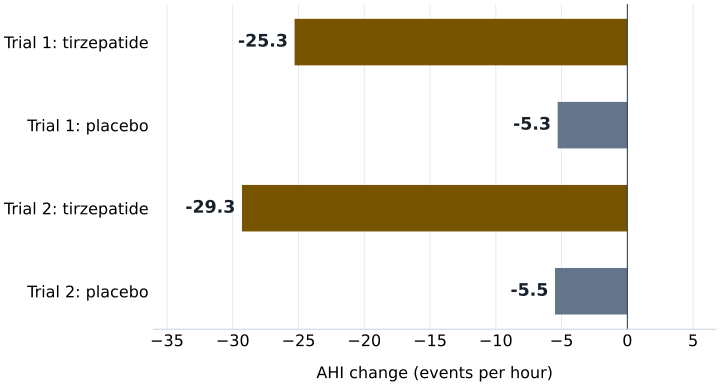
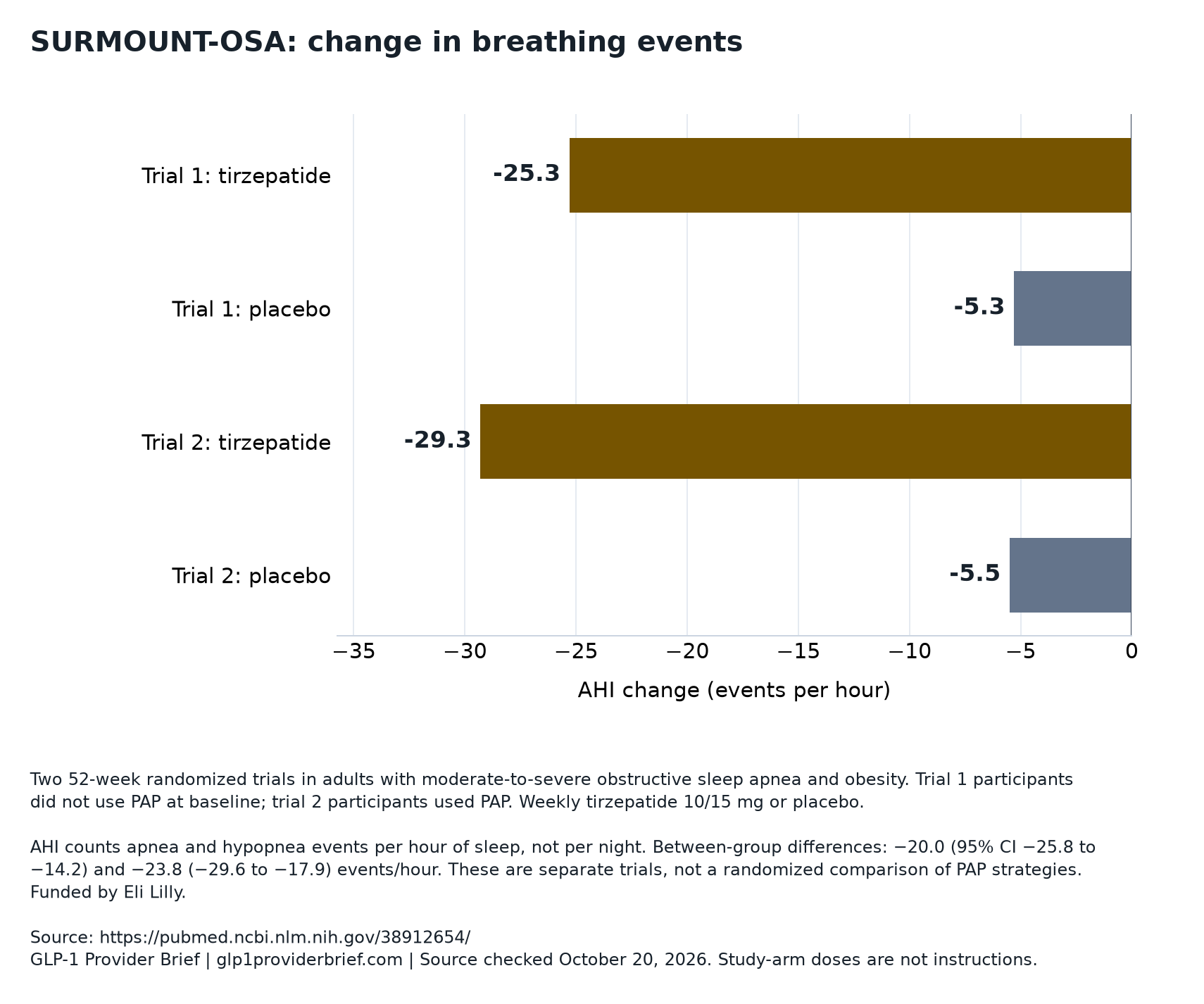
SURMOUNT-OSA: change in breathing events
Two 52-week randomized trials in adults with moderate-to-severe obstructive sleep apnea and obesity. Trial 1 participants did not use PAP at baseline; trial 2 participants used PAP. Weekly tirzepatide 10/15 mg or placebo.
| Study group | AHI change (events per hour) |
|---|---|
| Trial 1: tirzepatide | -25.3 |
| Trial 1: placebo | -5.3 |
| Trial 2: tirzepatide | -29.3 |
| Trial 2: placebo | -5.5 |
AHI counts apnea and hypopnea events per hour of sleep, not per night. Between-group differences: −20.0 (95% CI −25.8 to −14.2) and −23.8 (−29.6 to −17.9) events/hour. These are separate trials, not a randomized comparison of PAP strategies. Funded by Eli Lilly.
Original visualization of published aggregate data. No individual prediction or provider performance is represented. Original research ↗
AHI counts events per hour—not per night or a percentage
The primary endpoint was change from baseline in the apnea-hypopnea index, or AHI. An apnea is a breathing pause; a hypopnea is a reduction in breathing. AHI combines these events and expresses their frequency per hour of sleep. A decrease of 20 events per hour is therefore not 20 fewer events over an entire night and not a 20% reduction.
The hourly denominator matters. As a purely arithmetic illustration, an AHI of 50 across six hours of measured sleep corresponds to about 300 scored events. An AHI of 30 over the same duration corresponds to about 180. That illustration explains the unit; it is not an observed participant result, and it does not describe event duration or oxygen consequences.
AHI is useful because it standardizes event frequency, but it cannot capture every dimension of sleep apnea. Two people with similar AHI can differ in the depth or duration of oxygen disturbance and in how impaired they feel. That is why SURMOUNT-OSA also measured hypoxic burden and patient-reported sleep outcomes rather than relying on the event count alone.
Subtracting placebo change reveals the treatment contrast
In trial 1, mean AHI declined by 25.3 events per hour with tirzepatide and 5.3 with placebo. The estimated between-group difference was therefore −20.0 events per hour. In trial 2, the corresponding declines were 29.3 and 5.5, producing an estimated difference of −23.8. The negative signs indicate greater reductions with tirzepatide.
The full decline in the active-treatment group is not the same as the placebo-adjusted effect. Placebo participants also improved, so attributing all 25.3 or 29.3 fewer events per hour specifically to the drug would overstate the randomized contrast. The abstract does not establish how much of the placebo-group improvement reflected individual contributing factors.
The 95% confidence intervals for the treatment differences excluded zero in both trials. They quantify uncertainty around the estimated average contrast under the analysis assumptions; they are not ranges of individual response. Nor does trial 2’s numerically larger effect prove that baseline PAP use makes tirzepatide work better. That would require an appropriate comparison beyond simply placing two estimates side by side.
| Estimate | Trial 1 | Trial 2 |
|---|---|---|
| Tirzepatide mean change (95% CI) | −25.3 (−29.3 to −21.2) | −29.3 (−33.2 to −25.4) |
| Placebo mean change (95% CI) | −5.3 (−9.4 to −1.1) | −5.5 (−9.9 to −1.2) |
| Estimated treatment difference (95% CI) | −20.0 (−25.8 to −14.2) | −23.8 (−29.6 to −17.9) |
Large average improvements do not establish universal remission
A reduction of roughly 25 to 29 events per hour is substantial, but participants started with considerable breathing disturbance. Improvement and resolution are different claims. The accessible abstract does not provide the proportions reaching specific post-treatment disease categories, nor does it supply an individual-response distribution from which to estimate someone’s likelihood of remission.
A tempting shortcut is to subtract the treatment-group change from the reported overall trial baseline mean and label the result the treated group’s final AHI. That would be imprecise: the baseline figures summarize each trial, not necessarily the exact analysis population and baseline mean for each treatment arm. The defensible conclusion is major average improvement, not a reconstructed endpoint or cure rate.
Follow-up assessment therefore remains conceptually distinct from weight change or feeling better. A symptom improvement cannot by itself establish that breathing disturbances have resolved. These findings are not a recommendation to stop PAP; any change belongs with the treating clinician and appropriate diagnostic reassessment, rather than an advertised weight-loss milestone.
Oxygen stress and reported sleep improved, with numerical gaps
The prespecified key secondary endpoints included percentage change in AHI and body weight, hypoxic burden, patient-reported sleep impairment and disturbance, high-sensitivity C-reactive protein, and systolic blood pressure. Hypoxic burden reflects oxygen-related stress during sleep; high-sensitivity C-reactive protein is a marker of inflammation. These endpoints examine consequences and correlates that the AHI count alone misses.
The abstract reports statistically significant improvements versus placebo across all these key secondary endpoints. It also identifies them as multiplicity-controlled, meaning the statistical plan addressed the risk of false-positive findings from testing multiple outcomes. However, the accessible abstract does not supply their individual effect sizes or confidence intervals. Statistical significance alone cannot tell readers how large each benefit was or how noticeable it felt.
The findings are consistent with improvements across several dimensions, but they do not isolate a causal mechanism. Weight loss and better breathing occurred together; that does not quantify how much of the breathing benefit was mediated by weight change. Similarly, lower blood pressure or inflammation does not establish fewer heart attacks or deaths in this sleep apnea population.
Tolerability and durability need their own evidence
Gastrointestinal adverse events were the most frequently reported events with tirzepatide, and most were mild to moderate. This is a real tolerability finding, not evidence of an absence of harm. The indexed abstract does not provide specific gastrointestinal event rates, detailed serious-event counts, or discontinuation rates, limiting how precisely this analysis can describe the sleep trials’ safety experience.
The 52-week treatment period also sets a time boundary. It demonstrates outcomes during approximately one year of assigned treatment, not permanent benefit after withdrawal. NIDDK notes generally that weight-management medication duration depends on benefit and tolerability and that weight regain can occur after stopping. That general resource does not quantify post-treatment AHI changes in SURMOUNT-OSA.
Questions about maintenance deserve separate evidence rather than an assumption that the week-52 result persists indefinitely. The SURMOUNT-4 maintenance analysis examines how to read a randomized-withdrawal design; it should not be mistaken for a sleep apnea follow-up study. Missing here are quantified long-term sleep outcomes after treatment ends and a basis for promising lifelong resolution.
SUMMIT answers a different cardiovascular question
SUMMIT studied 731 patients with obesity and heart failure with preserved ejection fraction, defined in that trial by an ejection fraction of at least 50%. Participants received weekly subcutaneous tirzepatide up to 15 mg or placebo. Median follow-up was 104 weeks. Unlike SURMOUNT-OSA’s breathing-event endpoint, one SUMMIT primary endpoint combined cardiovascular death or a worsening heart-failure event in a time-to-first-event analysis.
That composite occurred in 9.9% with tirzepatide and 15.3% with placebo: a 5.4-percentage-point difference in observed proportions. The hazard ratio was 0.62, with a 95% confidence interval of 0.41 to 0.95. A hazard ratio describes relative event timing over follow-up, not the same quantity as the percentage-point difference. The SUMMIT analysis explores that distinction.
The lower composite did not mean every component improved. Cardiovascular deaths numbered eight versus five, with a hazard ratio of 1.58 and a wide confidence interval of 0.52 to 4.83; worsening heart-failure events were lower. Mainly gastrointestinal adverse events led to drug discontinuation in 6.3% versus 1.4%. SUMMIT, also funded by Eli Lilly, cannot establish cardiovascular outcome benefits for the separate SURMOUNT-OSA population.
A defensible service claim needs a traceable chain
A narrowly accurate statement would say that weekly injected tirzepatide reduced average AHI versus placebo over 52 weeks in adults with obesity and moderate-to-severe obstructive sleep apnea. Documentation should identify the study, population, treatment, timeframe, and endpoint. A stronger promise—such as guaranteed remission, freedom from PAP, or prevention of cardiovascular death—requires evidence these sleep trials do not supply.
Product identity is another boundary. FDA states that compounded drugs are not FDA approved or reviewed before marketing for safety, effectiveness, or quality, and recommends them only when a patient’s needs cannot be met by an approved drug. Findings for the studied product do not establish equivalence for compounded preparations, oral routes, or other formulations. FDA safety reports also cannot by themselves establish event rates or causation.
Editorial interpretation: transparent service terms are valuable, but they cannot bridge a clinical evidence gap. The evidence-boundaries guide separates those questions. Readers consulting the CoreAge Rx review can use it to check documentary terms—not as evidence that the provider offers the studied product, provides sleep apnea care, or reproduces trial outcomes.
Contracts should separate payment promises from clinical follow-up
The trials tested treatments, not subscription businesses, insurance policies, or refund guarantees. NIDDK emphasizes that medication decisions involve health history, other medicines, benefits, adverse effects, and cost, while coverage varies. An approval or favorable trial result therefore cannot establish that a particular person’s insurer will pay or that a service’s advertised price includes every relevant part of care.
Editorial interpretation: written terms should make clear what the service is promising to deliver, who handles treatment questions, and whether diagnostic follow-up is included or arranged elsewhere. A guarantee tied only to weight change would not demonstrate improvement in AHI. The billing-commitments guide can help distinguish a displayed monthly price from the actual financial commitment.
The same separation applies when reading the Mochi Health review: use it to examine membership documentation, not to infer condition-specific treatment or clinical results. Neither trial participation nor a published average tells a customer what a contract covers. Clinical monitoring, pharmacy fulfillment, cancellation rights, and insurance eligibility need their own written answers.
Questions & answers
Does a reduction of 20 events per hour mean sleep apnea improved by 20%?
No. Events per hour is an absolute frequency measure, whereas percent change depends on the starting value. For an illustrative baseline of 50 events per hour, a 20-event reduction would be 40%. That arithmetic is not a reported SURMOUNT-OSA percentage result. The −20.0 figure from trial 1 is specifically the estimated difference between treatment groups in their AHI changes, not a universal individual reduction.
Did the trials show that tirzepatide can replace PAP?
They did not directly compare tirzepatide with PAP or randomize participants to discontinue PAP. One trial enrolled people not receiving PAP, while the other enrolled people receiving it at baseline. Both randomized comparisons were against placebo. The findings support improved breathing-event frequency in those settings, not a general instruction to replace PAP. Treatment changes require clinician-led assessment rather than inference from the average trial effect.
Could someone feel better and still have residual sleep apnea?
Yes; symptom improvement and resolution of measured breathing abnormalities are different outcomes. SURMOUNT-OSA reported improvements in both AHI and patient-reported sleep measures, but the available abstract does not give enough information to classify every participant’s remaining disease. Feeling better or losing weight does not establish a normal AHI. Diagnostic follow-up addresses a question that symptom reports alone cannot settle.
Do these findings apply to compounded or oral tirzepatide?
The studies described here evaluated weekly injected tirzepatide, not every product carrying that ingredient name. They do not demonstrate equivalence for compounded preparations or oral routes. FDA notes that compounded drugs are not FDA approved and do not undergo premarket review for safety, effectiveness, or quality. A service citing SURMOUNT-OSA should clearly identify its product rather than implying that the trial validates an unspecified formulation.
What remains unknown after the one-year results?
Important questions include durability beyond 52 weeks, sleep apnea outcomes after treatment withdrawal, and how individual responses vary. The accessible abstract also lacks detailed numerical results for secondary endpoints and granular safety rates. It does not establish cardiovascular event prevention in this population. These gaps do not erase the randomized AHI benefit; they define which additional claims need further evidence rather than extrapolation.
Our assessment
SURMOUNT-OSA provides persuasive randomized evidence that tirzepatide reduced average breathing-event frequency and improved several related outcomes over 52 weeks in adults with obesity and moderate-to-severe obstructive sleep apnea. The placebo-adjusted differences were substantial in both baseline PAP settings. The strongest public-facing explanation preserves that achievement without converting it into universal remission, permission to stop PAP, or proof of cardiovascular protection. For service claims, the decisive test is traceability: does the advertised population, formulation, outcome, and timeframe match the research? Contract clarity can help people understand a purchase, but it cannot manufacture clinical equivalence or guarantee an individual result.
Sources & documentation
Scientific and official sources consulted October 20, 2026. Study findings apply to the populations, products and time periods described; they are not provider outcome data.
- Tirzepatide for the Treatment of Obstructive Sleep Apnea and Obesity. ↗
- FDA approval of Zepbound for obstructive sleep apnea, December 20, 2024 ↗
- NIDDK prescription medications for overweight and obesity ↗
- Tirzepatide for Heart Failure with Preserved Ejection Fraction and Obesity. ↗
- FDA concerns about unapproved GLP-1 drugs ↗