ESSENCE addresses a question that weight-loss percentages alone cannot answer: does treatment improve the liver tissue of people with metabolic dysfunction-associated steatohepatitis, or MASH? In its planned 72-week interim analysis, weekly injected semaglutide improved two biopsy-based outcomes compared with placebo. One measured disappearance of steatohepatitis without worsening scarring; the other measured reduced scarring without worsening steatohepatitis. These are meaningful tissue findings, but neither is a direct count of liver transplants prevented or lives extended.
The distinction matters because FDA has approved Wegovy injection for MASH with moderate-to-advanced fibrosis through its accelerated approval pathway. Calling this use merely investigational would miss that regulatory action. Equally, treating the interim results as proof of long-term survival benefit would outrun this analysis. This article examines the indexed primary research abstract and available official FDA material, rather than a complete review of the trial protocol, supplements, or full research article.
At a glance
- Population
- ESSENCE enrolled 1,197 patients with biopsy-defined MASH and stage F2 or F3 fibrosis; the planned 72-week analysis covered the first 800.Sources: [1]
- Study treatment
- Participants were randomized 2:1 to once-weekly subcutaneous semaglutide 2.4 mg or placebo, with a planned total trial duration of 240 weeks.Sources: [1]
- MASH resolution
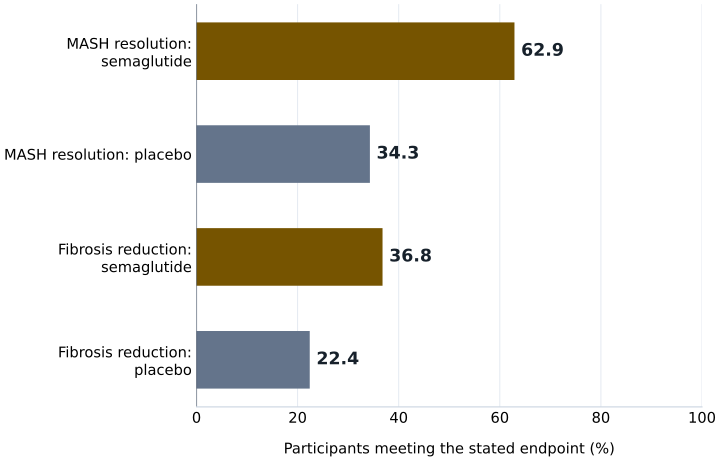
- Resolution without worsening fibrosis occurred in 62.9% versus 34.3%; the reported estimated difference was 28.7 percentage points, with a 95% confidence interval of 21.1 to 36.2.Sources: [1]
- Fibrosis improvement
- Reduced fibrosis without worsening steatohepatitis occurred in 36.8% versus 22.4%; the estimated difference was 14.4 percentage points, with a 95% confidence interval of 7.5 to 21.3.Sources: [1]
- Regulatory meaning
- FDA granted accelerated approval for Wegovy injection in adults with MASH and moderate-to-advanced fibrosis, with further data required to confirm clinical benefit.Sources: [2]
ESSENCE studied established liver disease, not weight alone
MASH involves liver fat accumulation accompanied by inflammation and injury, sometimes progressing to fibrosis, meaning scar tissue. ESSENCE required biopsy-defined MASH with stage F2 or F3 fibrosis: moderate or advanced scarring, but not cirrhosis. Its results therefore address a population with established tissue damage, not everyone with obesity, an abnormal liver blood test, or fat visible on an imaging scan.
That eligibility boundary helps explain why a weight-management assessment is not automatically equivalent to the trial’s disease assessment. A person may have metabolic risk factors without having the specific combination of inflammation and fibrosis studied here. Conversely, the trial’s central question was improvement in liver pathology, not whether participants qualified for a general weight-loss program.
The findings also should not be extended automatically to cirrhosis or earlier fibrosis stages. This is a question of which patients were actually studied, not a claim that benefit elsewhere is impossible. The evidence is strongest when the disease definition, scarring stage, treatment formulation, and endpoint all match.
How the trial separated treatment effects from comparison-group change
ESSENCE is an ongoing phase 3, multicenter, randomized, double-blind, placebo-controlled trial funded by Novo Nordisk. Random assignment reduces systematic differences between treatment groups; blinding limits the influence of knowing treatment assignment. Participants were assigned in a 2:1 ratio to once-weekly subcutaneous—under-the-skin—semaglutide 2.4 mg or placebo. The dose identifies the study arm, not a self-treatment instruction.
The full trial enrolled 1,197 people for a planned 240 weeks. This report concerns a prespecified interim analysis of the first 800 participants at week 72: 534 assigned semaglutide and 266 assigned placebo. It is therefore incorrect to describe the biopsy percentages as findings from all 1,197 participants or as the completed 240-week outcome.
FDA describes lifestyle changes in both groups and stable doses of lipid-lowering, glucose-management, and weight-loss medications. The comparison was not medication against no attention or no background care. Placebo-group improvement is part of the result: it shows why measuring change only among treated participants would exaggerate what can be attributed to treatment.
STUDY DATA · GLP-1 Provider Brief
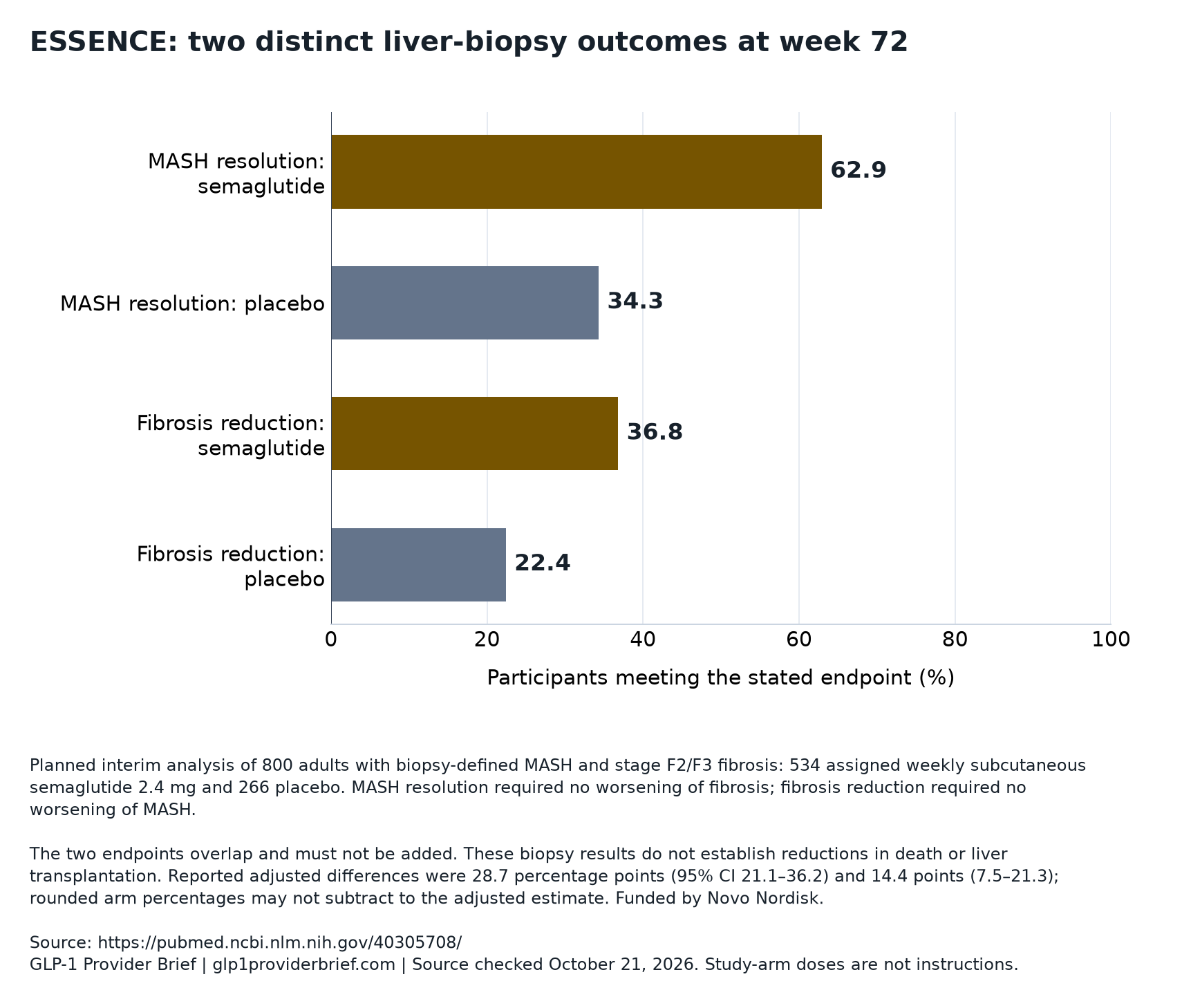
ESSENCE: two distinct liver-biopsy outcomes at week 72
Planned interim analysis of 800 adults with biopsy-defined MASH and stage F2/F3 fibrosis: 534 assigned weekly subcutaneous semaglutide 2.4 mg and 266 placebo. MASH resolution required no worsening of fibrosis; fibrosis reduction required no worsening of MASH.
| Study group | Participants meeting the stated endpoint (%) |
|---|---|
| MASH resolution: semaglutide | 62.9 |
| MASH resolution: placebo | 34.3 |
| Fibrosis reduction: semaglutide | 36.8 |
| Fibrosis reduction: placebo | 22.4 |
The two endpoints overlap and must not be added. These biopsy results do not establish reductions in death or liver transplantation. Reported adjusted differences were 28.7 percentage points (95% CI 21.1–36.2) and 14.4 points (7.5–21.3); rounded arm percentages may not subtract to the adjusted estimate. Funded by Novo Nordisk.
Original visualization of published aggregate data. No individual prediction or provider performance is represented. Original research ↗
Two primary endpoints asked different liver questions
The first primary endpoint required steatohepatitis resolution without worsening fibrosis. In plain language, the inflammatory disease pattern had to resolve while scarring did not get worse. This is not the same as complete normalization of the liver or elimination of existing scar tissue. Improvement in one dimension was paired with a safeguard against deterioration in another.
The second primary endpoint reversed the emphasis: fibrosis had to decrease without worsening steatohepatitis. Someone could meet this endpoint while still having inflammatory disease. Keeping these definitions separate prevents a broad statement such as “the liver disease disappeared” from replacing the more specific result.
Both endpoints favored semaglutide, but the effect sizes differed. The larger difference concerned resolution of steatohepatitis; the smaller concerned fibrosis reduction. That pattern supports improvement in both measured domains while reminding readers that resolving inflammation and reducing established scarring are not interchangeable biological achievements.
| Outcome | Semaglutide vs. placebo | Reported estimated difference, percentage points (95% CI) |
|---|---|---|
| Steatohepatitis resolution without worsening fibrosis | 62.9% vs. 34.3% | 28.7 (21.1 to 36.2) |
| Fibrosis reduction without worsening steatohepatitis | 36.8% vs. 22.4% | 14.4 (7.5 to 21.3) |
| Both steatohepatitis resolution and fibrosis reduction | 32.7% vs. 16.1% | 16.5 (10.2 to 22.8) |
Reading the percentages without overstating precision
For the resolution endpoint, 62.9% versus 34.3% means that roughly 63 versus 34 participants per 100 met the defined outcome in their respective groups. The report’s adjusted estimated difference was 28.7 percentage points. Subtracting the displayed, rounded percentages gives 28.6; that small discrepancy is not a reason to replace the reported estimate with hand arithmetic.
The 95% confidence interval of 21.1 to 36.2 percentage points expresses uncertainty around that estimated treatment difference. It does not mean that 95% of individuals experienced an improvement within that range. For fibrosis reduction, the estimated advantage was 14.4 percentage points, with a 95% confidence interval of 7.5 to 21.3. Both intervals exclude zero, supporting a treatment-group difference.
These are absolute percentage-point differences in biopsy-response proportions, not hazard reductions over time. They also are not promises about an individual’s response. The semaglutide group’s response proportion remained below 100% for every reported biopsy endpoint, and its fibrosis-response proportion was substantially lower than its steatohepatitis-resolution proportion.
Joint improvement adds information, not another group to total
The combined secondary outcome required both steatohepatitis resolution and fibrosis reduction. It occurred in 32.7% of semaglutide participants and 16.1% of placebo participants. The reported estimated difference was 16.5 percentage points, with a 95% confidence interval of 10.2 to 22.8. This result addresses the more demanding question of improvement in both dimensions together.
These outcome categories overlap. A participant meeting the joint outcome can also satisfy each primary endpoint, so adding the three percentages would count some people repeatedly. The joint result is not an additional 32.7% of participants benefiting beyond those already represented by the primary outcomes.
The abstract identifies this joint outcome, body-weight change, and bodily pain as secondary outcomes included in a plan to adjust for multiple testing. Such planning matters because testing many questions increases opportunities for chance-positive results. It does not make every secondary result positive: bodily pain scores did not differ significantly between groups.
Weight loss accompanied liver improvement, without proving the mechanism
Mean body-weight change was −10.5% with semaglutide and −2.0% with placebo. The estimated between-group difference was −8.5 percentage points, with a 95% confidence interval of −9.6 to −7.4. These are average percentage changes from starting weight, not percentages of participants who lost weight or fixed amounts of weight in pounds.
Weight reduction and better liver histology occurred within the same randomized comparison. That does not, by itself, establish how much liver benefit was caused by weight loss versus other pathways. FDA describes weight loss and possible additional mechanisms that are not fully understood. The accessible abstract does not provide a mediation analysis separating those contributions.
Similar weight-loss numbers from another drug would not establish equivalent liver effects. The separate ATTAIN-1 oral orforglipron analysis concerns an oral small-molecule GLP-1 receptor agonist in obesity without diabetes, with weight change as its primary endpoint. A shared drug class or 72-week duration does not substitute for an ESSENCE-style biopsy study.
Safety findings are real, but the abstract leaves important counts unavailable
Gastrointestinal adverse events were more common with semaglutide in ESSENCE. That is the trial-specific safety finding available in the indexed abstract. The abstract does not provide event counts, severity distributions, or treatment-discontinuation percentages, so this analysis cannot calculate those comparisons or characterize the trial as uniformly well tolerated.
FDA’s approval announcement lists common Wegovy effects including nausea, diarrhea, vomiting, constipation, and abdominal pain, among others. These product-level safety statements are not numerical ESSENCE results. The announcement also identifies restrictions involving personal or family history of medullary thyroid cancer, multiple endocrine neoplasia type 2, and known sensitivity to semaglutide or product ingredients.
A trial report and an approval announcement do not replace complete current prescribing information. From an editorial care-planning perspective, the practical issue is whether treatment questions and adverse effects have an identifiable clinical response pathway. The guide to provider responsibilities distinguishes platform, clinician, and pharmacy roles without treating a service arrangement as evidence of safety.
Accelerated approval recognizes a surrogate—not a completed survival result
FDA approved Wegovy injection for adults with MASH and moderate-to-advanced fibrosis through accelerated approval. This pathway allows earlier approval for a serious condition using a surrogate endpoint, with additional evidence required to confirm a clinically meaningful benefit. Here, the central supporting measure was liver histology—the tissue appearance assessed by biopsy.
A surrogate is useful because it can show disease-related change before enough major clinical events accumulate. But improved biopsy findings are not themselves proof of fewer deaths, liver transplants, or episodes of worsening liver function. FDA describes the trial’s planned 240-week continuation as testing whether the earlier improvements translate into fewer deaths, transplants, and other liver-related events.
The precise conclusion is therefore two-part: the 72-week report establishes better biopsy outcomes in this randomized population, and the FDA action establishes an accelerated MASH indication. This analysis does not establish the trial’s longer-term clinical outcomes. It also does not assert that no later evidence exists; its conclusions are tied to the specific interim report examined here.
SELECT and FLOW answer different organ-outcome questions
SELECT enrolled 17,604 adults aged at least 45 with established cardiovascular disease, BMI of at least 27, and no diabetes history. With the same weekly injected semaglutide dose studied in ESSENCE, its cardiovascular composite occurred in 6.5% versus 8.0% over a mean 39.8 months of follow-up. The hazard ratio was 0.80, with a 95% confidence interval of 0.72 to 0.90—not a 20-percentage-point absolute reduction.
FLOW studied 3,533 people with type 2 diabetes and chronic kidney disease, using weekly injected semaglutide 1.0 mg. Over median follow-up of 3.4 years, its primary composite produced 331 versus 410 first events; the hazard ratio was 0.76, with a 95% confidence interval of 0.66 to 0.88. The FLOW kidney-outcomes analysis explains why that result belongs to a specific kidney-risk population.
These Novo Nordisk-funded studies broaden the evidence for semaglutide, but they do not supply missing ESSENCE liver-event results. Nor does a lower composite hazard prove that every component improved individually. Safety measures differ as well: SELECT reported adverse-event-related permanent discontinuation of 16.6% versus 8.2%, while FLOW reported serious adverse events in 49.6% versus 53.8%. Those measures cannot be used as ESSENCE safety rates.
| Trial and population | Studied intervention vs. placebo | Primary outcome and reported follow-up |
|---|---|---|
| ESSENCE: biopsy-defined MASH with F2/F3 fibrosis | Semaglutide 2.4 mg, weekly subcutaneous injection | Two biopsy endpoints; planned interim analysis at 72 weeks |
| SELECT: established cardiovascular disease, overweight or obesity, no diabetes | Semaglutide 2.4 mg, weekly subcutaneous injection | Cardiovascular death, nonfatal heart attack, or nonfatal stroke; mean follow-up 39.8 months |
| FLOW: type 2 diabetes with chronic kidney disease | Semaglutide 1.0 mg, weekly subcutaneous injection | Major kidney disease events or kidney-related/cardiovascular death; median follow-up 3.4 years |
Translating the evidence into documentary questions about a service
Editorial interpretation: the first commercial question is what exact product is being discussed. ESSENCE does not validate all products labeled semaglutide, oral formulations, or compounded preparations. FDA states that compounded drugs are not FDA approved and do not undergo its premarket review for safety, effectiveness, and quality. It also identifies semaglutide salt forms as different active ingredients from those used in approved drugs.
FDA has received reports of dosing errors involving compounded injectable semaglutide, some requiring hospitalization. These reports are a separate safety signal, not a randomized comparison against the ESSENCE product. The product-terms guide helps separate formulation descriptions from broad class-based marketing. Neither the trial nor an attractive contract establishes equivalence between formulations.
Editorial interpretation: eligibility assessment, clinical follow-up, pharmacy fulfillment, and billing commitments deserve separate written answers. The billing-commitments guide addresses why a monthly price need not mean a monthly commitment. Readers examining the CoreAge Rx review can use it to check documentary terms; that invitation makes no claim that the provider supplies the studied product, offers MASH-specific care, or reproduces ESSENCE outcomes.
Questions & answers
Does MASH resolution mean all liver scarring disappeared?
No. The primary resolution endpoint required steatohepatitis to resolve without fibrosis worsening; existing fibrosis did not have to disappear. Fibrosis reduction was a separate primary endpoint. The joint secondary outcome required both resolution and fibrosis reduction, but even that wording does not mean the liver became entirely normal.
Why did so many placebo participants improve?
The report documents improvement but does not establish a single explanation for it. FDA describes lifestyle changes in both groups and stable background medications. The randomized comparison measures the additional treatment-group advantage beyond changes occurring in the placebo group; attributing every treated participant’s improvement to semaglutide alone would ignore that comparison.
Did ESSENCE show that semaglutide prevents liver transplantation?
The examined 72-week interim report did not establish that outcome. It measured biopsy-defined changes. FDA describes continued follow-up to 240 weeks as evaluating whether those improvements translate into fewer deaths, liver transplants, and other liver-related events. Tissue response and prevention of major clinical events are related questions, not identical endpoints.
Is semaglutide still investigational for MASH?
FDA has granted Wegovy injection an accelerated MASH indication for adults with moderate-to-advanced fibrosis. That approval should not be confused with blanket approval of every semaglutide formulation or GLP-1 product for liver disease. Accelerated approval also carries a requirement for additional data confirming clinical benefit.
Can a provider promise the trial’s response rate to an individual?
No individual response is guaranteed by a group average. The trial studied a defined population receiving a specific intervention under a research protocol. Editorial interpretation: a contract can document product identity, service responsibilities, and payment obligations, but it cannot turn the trial’s response percentage into a personal outcome guarantee.
Our assessment
ESSENCE provides persuasive randomized evidence that weekly injected semaglutide improved biopsy-defined steatohepatitis and fibrosis outcomes over 72 weeks in patients with noncirrhotic F2/F3 MASH. The primary estimates were substantial, and their confidence intervals favored treatment. The strongest reading preserves the endpoint definitions, acknowledges more gastrointestinal adverse events, and separates the FDA’s accelerated approval from confirmation of longer-term clinical benefit. For commercial-service evaluation, product identity and documented responsibilities are relevant questions—not substitutes for the liver evidence.
Sources & documentation
Scientific and official sources consulted October 21, 2026. Study findings apply to the populations, products and time periods described; they are not provider outcome data.
- Phase 3 Trial of Semaglutide in Metabolic Dysfunction-Associated Steatohepatitis. ↗
- FDA approves treatment for serious liver disease known as MASH ↗
- Orforglipron, an Oral Small-Molecule GLP-1 Receptor Agonist for Obesity Treatment. ↗
- Semaglutide and Cardiovascular Outcomes in Obesity without Diabetes. ↗
- Effects of Semaglutide on Chronic Kidney Disease in Patients with Type 2 Diabetes. ↗
- FDA concerns with unapproved GLP-1 drugs used for weight loss ↗